
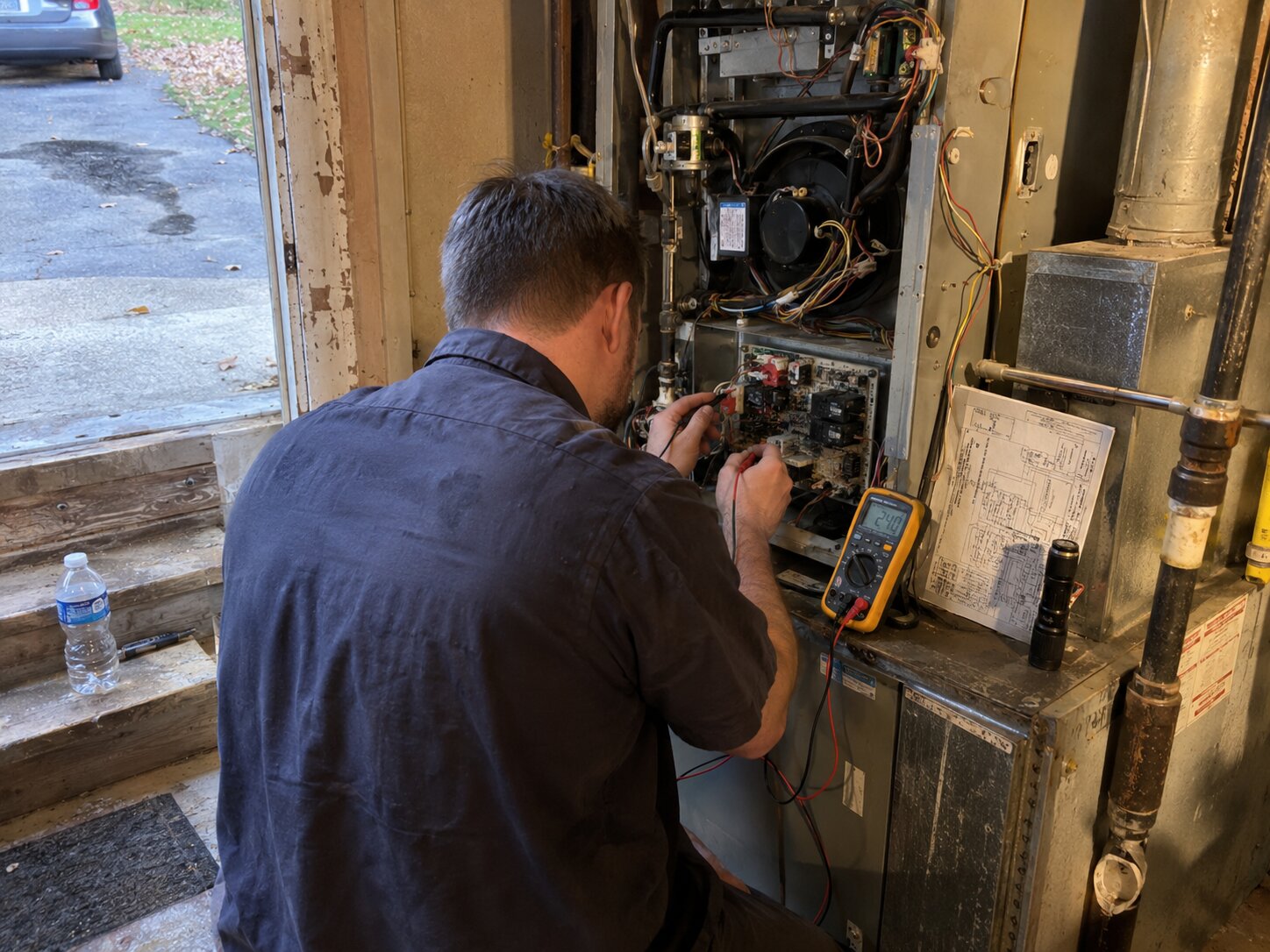
Heat Exchanger Inspection & Repair in Lexington, KY
The phrase no homeowner wants to hear from an HVAC technician on a January afternoon: “your heat exchanger is cracked.” It usually arrives alongside a recommendation to replace the furnace, a quote in the thousands, and pressure to decide fast because “you can’t keep using a furnace with a cracked heat exchanger — it’s a carbon monoxide risk.” That sequence is partly correct and partly the most over-diagnosed failure in residential HVAC. A genuinely cracked heat exchanger is a real safety issue that requires action. A “cracked heat exchanger” diagnosed in 30 seconds without visual or combustion-analyzer evidence is sometimes a sales technique. Lexington Heating and Air inspects heat exchangers across Fayette County the way the diagnosis deserves to be done: with a borescope, a combustion analyzer, and the willingness to show you what we actually see — positive or negative.
What the Heat Exchanger Does
The heat exchanger is the metal wall that separates two streams of air that must never mix. On one side, the burners produce combustion gases — mostly carbon dioxide and water vapor when combustion is clean, with small amounts of nitrogen oxides and, importantly, the potential for carbon monoxide if combustion is incomplete. On the other side, your home’s supply air passes over the hot metal surface, picking up heat without ever directly touching combustion gas. The exchanger then directs combustion gases up the flue and out of the home, while sending the heated supply air through your ductwork.
This separation is the entire safety premise of a gas furnace. If the metal wall develops a crack, fissure, or hole, combustion gases can leak into the supply air and be circulated through the ducts into living spaces. Carbon monoxide is colorless, odorless, and dangerous at concentrations measured in parts per million. A genuinely cracked exchanger is a safety condition. The diagnostic question is: is it actually cracked?
How Heat Exchangers Fail
- Thermal fatigue. Steel expands and contracts with every heating cycle. Over thousands of cycles across 15–20 years, the metal eventually fatigues at high-stress points. The most common natural failure mode and usually develops on units near or past their expected service life.
- Manufacturing defects. Rare but real. Some manufacturers have had recall campaigns for specific heat exchanger problems. We check serial numbers against active recall lists where applicable.
- Repeated overheating. A furnace that consistently overheats — due to airflow restriction from clogged filters, undersized ductwork, oversized equipment for the home, or a failing blower — ages the exchanger faster than design assumptions. Overheating stress is also why oversized furnaces sometimes fail their heat exchangers in 10–12 years rather than 18–20.
- Corrosion. Condensate flowing back into a non-condensing heat exchanger, water intrusion from leaks above the furnace, or unusual combustion chemistry can all cause corrosion through-failures. More common in basements with humidity issues, which describes a meaningful portion of older Lexington homes.
- Damage from improper service. Tools dropped during repairs, improper cleaning, sheet-metal modifications that stress the exchanger — rare but real causes.
Why Heat Exchangers Are Over-Diagnosed
Two reasons, and both deserve plain language:
First, the diagnosis is genuinely hard without good equipment. Heat exchangers are mostly hidden inside the furnace cabinet, accessible only through small inspection ports. Confirming a crack often requires a borescope camera and patience, both of which add time to a service call. A technician without that equipment, or in a hurry, can call a crack based on a hunch — soot patterns, flame irregularity, or a “feel” — without ever seeing one.
Second, the recommendation that follows is a large sale. A cracked heat exchanger usually means furnace replacement (the exchanger itself is repairable only rarely, and almost never economically out of warranty). On an older system, this can be a $5,000–$10,000 conversation. The financial incentive to find cracks where they aren’t is real, and the consumer-protection literature on the trade has documented the pattern for decades. This is not a conspiracy theory; it’s a known issue.
The protection against over-diagnosis is simple: insist on seeing the evidence. A real cracked exchanger can be shown on a borescope. A real CO condition can be shown on an analyzer reading from your supply air. If a contractor cannot or will not show you the evidence, the diagnosis is incomplete.
How We Diagnose a Suspected Cracked Heat Exchanger
- Combustion analysis. CO and O₂ readings in the flue gas first, then critically, CO readings in the supply air at multiple registers throughout the home. Clean supply air with elevated flue CO is one pattern; CO in the supply air is a different and more serious one.
- Visual inspection with a borescope. A flexible camera inserted through inspection ports to examine each section of the heat exchanger. We document findings with photos.
- Flame pattern observation. An exchanger with a crack often disturbs the burner flame when the blower kicks on (the blower’s pressure differential pulls air through the crack, flickering the flame in a characteristic way). Real, but not diagnostic by itself.
- Pressurization testing in some cases. Sealing the exchanger and pressurizing it can reveal leaks, though this is more invasive and reserved for ambiguous cases.
- Verification of recall status. Cross-referencing make, model, and serial number against active manufacturer recalls.
If the Exchanger Is Cracked: Your Options
- Manufacturer warranty. Many residential heat exchangers carry long warranties (often 20 years to lifetime on the exchanger part specifically). If your furnace is still in warranty, the exchanger part may be covered — though labor, refrigerant, and other materials typically aren’t. We help check warranty status.
- Exchanger replacement. Possible on some models, but labor-intensive and frequently not economical out of warranty. Usually only makes sense for newer systems still under warranty.
- Furnace replacement. The more common path on out-of-warranty systems. We provide an itemized quote, factor in Section 25C tax credit eligibility on high-efficiency replacements, and walk through the decision with you.
- Heat pump alternative. If your furnace is at the point of replacement, this is a natural moment to evaluate whether a heat pump (or dual-fuel system) makes better long-term sense than another gas furnace.
Frequently Asked Questions
- Is a cracked heat exchanger really dangerous?
- If it’s genuinely cracked and circulating combustion gases into the supply air, yes — it can introduce carbon monoxide into living spaces, and CO is dangerous at concentrations measured in parts per million. That said, “cracked heat exchanger” is also one of the most over-diagnosed conditions in residential HVAC, and a contractor should be able to show you the crack visually (borescope) and the CO reading (combustion analyzer) before condemning a furnace. Insist on seeing the evidence.
- How do you actually inspect a heat exchanger?
- We use a borescope camera inserted through the furnace’s inspection ports to look at each section of the exchanger and document any findings. We pair that with combustion analysis — measuring CO and O₂ in the flue gas and CO in the supply air at multiple registers. We also observe the flame pattern when the blower starts, which can reveal exchanger leaks in a characteristic way. Visual and analyzer evidence together, not just a hunch.
- Should I get a second opinion if I’m told my heat exchanger is cracked?
- Yes, particularly if you weren’t shown the evidence (borescope images, CO readings in supply air) and the recommendation is full furnace replacement. Heat exchanger diagnoses can be inaccurate when done without proper equipment, and replacement is a significant expense. A second opinion that uses a borescope and combustion analyzer either confirms the first diagnosis (in which case you proceed with confidence) or doesn’t (in which case you saved a meaningful sum). We’re glad to provide one.
- Can a cracked heat exchanger be repaired, or do I need a new furnace?
- Repair is possible on some models but labor-intensive and rarely economical out of warranty. If your furnace is still under the manufacturer’s heat exchanger warranty (often 20 years or lifetime on the part), the part itself may be covered, with labor and materials typically not. For older out-of-warranty furnaces, replacement is usually the more practical path. We give you the honest cost comparison.
- What causes a heat exchanger to crack in the first place?
- The most common cause is thermal fatigue from years of expansion and contraction across thousands of heating cycles, typically near or past the expected service life. Other causes include repeated overheating (from airflow restriction or oversizing), corrosion (water intrusion, condensate issues, basement humidity), and rarely, manufacturing defects. Regular maintenance with combustion analysis catches the conditions that accelerate failure.
Get an Honest Heat Exchanger Inspection
Before you accept a heat exchanger verdict — or a furnace replacement quote — get the diagnosis done with a borescope, a combustion analyzer, and a technician willing to show you the evidence. Across Lexington and Fayette County.
- Phone: (859) 215-5241
- Address: 343 Cassidy Ave, Lexington, KY 40502
- Email: [add business email before publishing]