
Heating Services in Lexington, KY
A Kentucky winter is not the dry, deep freeze of the northern plains, nor the mild season of the lower South. It is wet cold — sustained stretches of temperatures in the 20s and 30s with humidity that drives moisture into every poorly sealed wall and every flue connection. That damp cold is genuinely harder on heating equipment than dry cold of the same temperature, and it makes proper combustion, venting, and heat exchanger inspection critical to both efficiency and safety. When a furnace quits at 3 a.m. on a January night with the windchill at 8°F, “we’ll be there next Tuesday” is not an acceptable answer. Lexington Heating and Air handles every part of home and commercial heating across Fayette County: gas furnaces, modern heat pumps suited to our Climate Zone 4A, the older boilers and hydronic systems still common in historic Lexington neighborhoods, and the gas line work that connects all of it. With the combustion testing and carbon monoxide vigilance that gas heat deserves.
Our Heating Services
Explore each service below, or call (859) 215-5241 to talk through what your system needs.
- Furnace Installation — high-efficiency 90%+ AFUE condensing furnaces and standard 80% AFUE furnaces, sized with a Manual J load calculation and installed to current Kentucky mechanical code with verified venting.
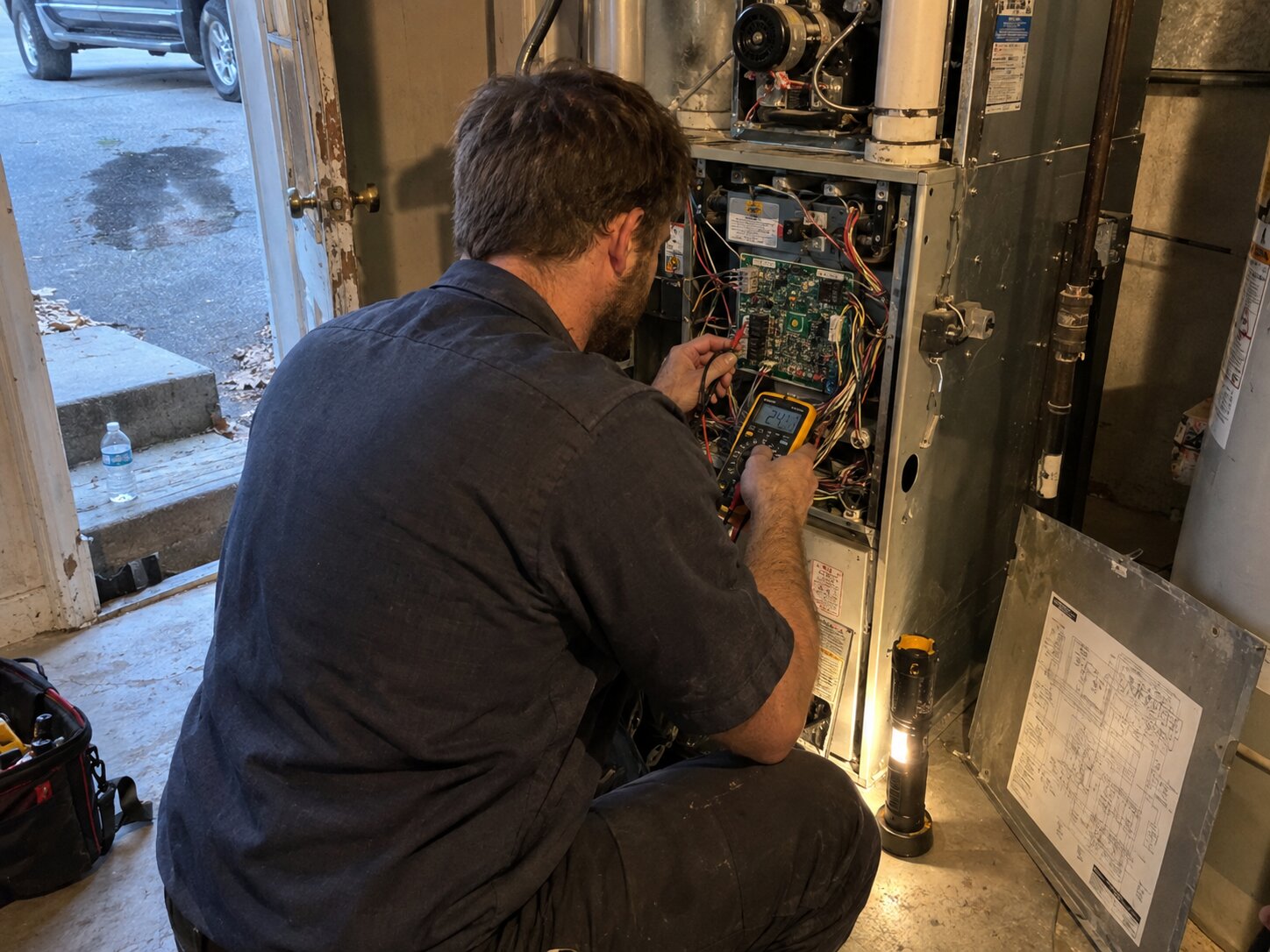
- Furnace Repair — fast, accurate diagnosis when your furnace stops heating, short-cycles, won’t ignite, or makes unusual noises.
- Furnace Tune-Up — fall maintenance with full combustion analysis (CO, O₂, flue temperature, stack efficiency) to keep your furnace safe and efficient through winter.
- Heat Pumps — installation and service of standard and cold-climate heat pumps, sized for Lexington’s winter design temperature, not the optimistic mild-day rating.
- Heat Exchanger Repair — inspection, repair, and honest assessment of cracked heat exchangers, the failure that most directly creates carbon monoxide risk.
- Boiler Installation — modern condensing and non-condensing boilers for the hydronic and radiant heating systems common in older Lexington homes.
- Boiler Repair — diagnosis and repair of boiler, expansion tank, circulator pump, and hydronic distribution issues.
- Gas Line Installation — safe, code-compliant black iron or CSST gas piping for heating equipment, appliances, and exterior connections, pressure-tested before being put into service.
Why Heating Is Different in Central Kentucky
Cold and Damp, Not Just Cold
Lexington sits in Climate Zone 4A — mixed-humid — where winters bring sustained cold and dampness rather than the dry deep freeze of the northern plains. Damp cold has practical consequences for heating equipment. Humid combustion air condenses in flue passages of lower-efficiency furnaces, accelerating corrosion in non-condensing heat exchangers. Crawl spaces and basements with poor sealing pull damp outside air into the combustion zone, changing how the equipment fires. Proper venting and a tight combustion air pathway aren’t optional refinements here — they’re the difference between a furnace that runs reliably for 18 years and one that fails at year 11.
Old Homes and New Homes, Side by Side
Heating a 1920s home in Ashland Park or Chevy Chase — often with original ductwork sized for an older gravity furnace, plaster walls, single-pane windows, and sometimes a converted boiler from earlier decades — is a fundamentally different job than heating a tightly insulated new home in Andover or Hamburg. The older homes carry heating loads that can be double what the square footage suggests, with airflow paths designed for equipment that no longer exists. Modern construction carries far less load but is more sensitive to oversized equipment (which can short-cycle and create comfort complaints). We assess each home on its own terms, not by a tonnage-per-square-foot rule.
Safety Comes First: Carbon Monoxide
Gas heating equipment commands respect. Cracked heat exchangers, improper venting, blocked flues, depleted oxygen from negative pressure caused by other appliances — any of these can release carbon monoxide into the air your family breathes. CO is colorless, odorless, slightly less dense than air, and dangerous at concentrations measured in parts per million. The CDC estimates carbon monoxide causes hundreds of accidental U.S. deaths and tens of thousands of emergency department visits every year — most preventable. Every heating service we perform includes attention to combustion safety. Every tune-up includes combustion analysis with a calibrated analyzer measuring CO, O₂, and stack temperature. Every home with gas appliances should have working CO detectors on every level — not battery-powered ones whose batteries are dead, working ones.
Signs You Need Heating Service
- The furnace runs but the house won’t warm up, or heats unevenly room to room.
- Short-cycling — the system turns on and off in rapid bursts without satisfying the thermostat.
- Unusual noises: banging on ignition (often delayed ignition, a real safety concern), rattling, persistent clicking without firing, or sustained mechanical grinding.
- A yellow or orange burner flame instead of blue, or soot accumulating on or around the unit.
- The CO detector has alerted, even briefly.
- Rising heating bills with no change in usage patterns.
- The system is more than 15 years old, or it shows soft spots, rust, or moisture damage on inspection.
- The pilot light or igniter cycles without successful firing.
Frequently Asked Questions
- Why is my furnace running but not heating the house?
- Common causes include a failed igniter or flame sensor (one of the most frequent faults on Lexington furnaces five years old or more), a clogged condensate trap on a 90%+ AFUE high-efficiency unit, a stuck pressure switch, a tripped limit switch, or a thermostat issue. These have the same symptom but very different repair costs, which is why we diagnose with measurements rather than guessing.
- Is a heat pump a good choice for heating in Lexington?
- Yes. Fayette County’s Climate Zone 4A is genuinely well-suited to modern heat pumps, which heat efficiently through most of our winter and also handle cooling. The key is sizing the unit for Lexington’s actual winter design temperatures (roughly 6 to 10 degrees Fahrenheit in central Kentucky) so it delivers full heating capacity during a January cold snap, typically paired with electric resistance auxiliary heat or a gas backup. Properly sized modern heat pumps qualify for federal Section 25C tax credits.
- How often should my heating system be serviced?
- Once a year, ideally in early fall before the heating season begins. An annual tune-up includes combustion analysis, safety checks for issues like cracked heat exchangers and improper venting, electrical testing, and cleaning that keeps the system efficient. Beyond efficiency, the safety reasons are real: it’s how we catch carbon monoxide risks before they become dangerous.
- What’s the danger of a cracked heat exchanger?
- A cracked heat exchanger can allow combustion gases — including carbon monoxide — to mix with the air circulating through your home through the supply registers. Because CO is colorless and odorless and dangerous at concentrations of just a few hundred parts per million over time, this is a serious safety issue. We inspect heat exchangers carefully with cameras and combustion analyzer readings and will always show you the evidence rather than simply condemning a unit, so you can make an informed decision rather than a pressured one.
- What heating systems do you service?
- We install, repair, and maintain gas furnaces (single-stage, two-stage, modulating, condensing and non-condensing), heat pumps (standard and cold-climate), and boilers (condensing and non-condensing, hydronic and steam), and we handle gas line work. That covers the full range of central Kentucky homes, from modern high-efficiency furnaces in newer construction to the older boilers and hydronic systems found in historic Lexington neighborhoods.
Schedule Heating Service in Fayette County
Fall tune-up appointments fill up September and October. Furnace repair calls peak during the first sustained cold snap and again on the morning after holidays when systems get pushed hardest. Boiler service for older Lexington homes runs through the heating season. Call to schedule whichever applies to your system.
- Phone: (859) 215-5241
- Address: 343 Cassidy Ave, Lexington, KY 40502
- Email: [add business email before publishing]