
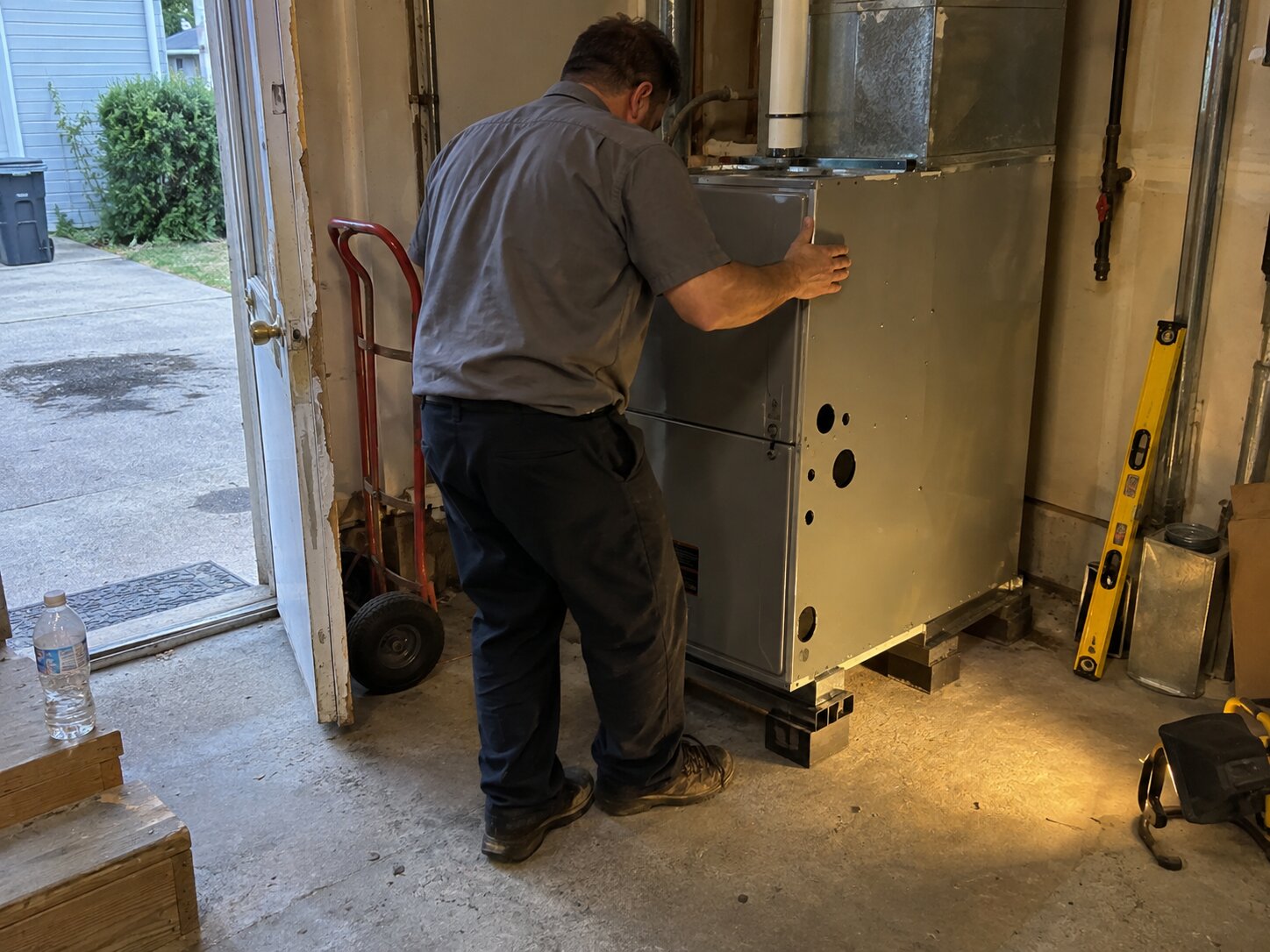
Furnace Installation in Wilmore, KY
Furnace installation in Wilmore works with the housing reality of a small Jessamine County college town: smaller residential properties, older construction in significant numbers, faculty housing around the Asbury campuses with owner-occupants who care about maintenance and lifecycle cost, and rental properties where landlord priorities shape installation decisions. Heating loads are typically more modest than the larger newer homes in subdivisions elsewhere in our service area, but the integration work matters just as much. A 95%+ AFUE condensing furnace installed correctly in a 1,400-square-foot Wilmore home will run quietly for two decades at rating-plate efficiency; the same equipment installed without proper venting, condensate management, or combustion verification will struggle and cost more in repairs than the efficiency tier savings recover. Lexington Heating and Air installs gas furnaces across Wilmore with the same discipline we apply across our service area — Manual J load calculation, proper integration work, combustion verification at startup.
The 80% vs. 95%+ AFUE Decision
80% AFUE Standard Efficiency
- How it works. Non-condensing combustion, vented through B-vent (metallic flue) using natural draft.
- Pros. Lower first cost. Simpler installation. No condensate management. Existing B-vent chimneys can often be reused. Reliable, well-understood technology.
- Cons. 20% of combustion energy goes up the flue. Higher gas bills over the equipment’s life. Does not qualify for Section 25C federal tax credit.
- Where it fits in Wilmore. Older homes with existing B-vent infrastructure where conversion to PVC sidewall venting would be expensive. Rental property situations where capital cost dominates the landlord’s decision. Homes being prepared for sale where first cost matters most.
95%+ AFUE High-Efficiency (Condensing)
- How it works. Condensing combustion extracts additional heat by condensing water vapor in a secondary heat exchanger. Vents through PVC sidewall; produces several gallons of acidic condensate per day requiring drainage.
- Pros. Substantially lower gas usage. Qualifies for Section 25C federal tax credit on qualifying installations. PVC sidewall venting eliminates chimney issues. Sealed combustion improves indoor air quality.
- Cons. Higher first cost. Requires condensate management with proper drain pitch and freeze protection. The condensate trap is a maintenance point (the hard-water clog issue specific to the Bluegrass region).
- Where it fits in Wilmore. Most owner-occupied installations in central Kentucky’s longer heating season. Most homes considering Section 25C credit eligibility. Tightly built newer construction.
Smaller Homes Need the Same Discipline as Larger Ones
The temptation in a small home is to skip the Manual J load calculation and pick “the smallest residential furnace they make,” which on most lines is 40,000-45,000 BTU. Sometimes that’s correct. Sometimes a 1,200-square-foot 1920s bungalow with original windows and minimal insulation actually needs the same furnace capacity as a much larger but tighter newer home. Sometimes a tightly built 1,800-square-foot home with current-code insulation needs less heat than the rule-of-thumb assumes. The right answer is the actual calculation for the specific home. Oversizing causes the same short-cycling, uneven heating, and equipment wear in small homes as in large ones — sometimes more dramatically because the cycling happens faster.
What Proper Furnace Installation Includes
- In-home assessment with Manual J load calculation.
- Equipment selection matching capacity to load and efficiency tier to your situation.
- Venting design. B-vent for 80% AFUE, PVC sidewall for 95%+ AFUE. Termination distance from windows, intakes, and property lines per code.
- Gas piping sized for the new equipment’s BTU input.
- Combustion air supply verified, either from indoor environment or sealed-combustion intake.
- Condensate management on high-efficiency installations.
- Electrical service — dedicated circuit, proper wire sizing, disconnect within sight per code.
- Jessamine County permit pulled and inspection arranged.
- Commissioning — combustion analysis measuring CO and O₂ in flue gas, supply air CO at registers, manifold gas pressure verified, temperature rise within spec.
- Walkthrough on operation, filter location, warranty registration completed.
Why Combustion Verification at Startup Matters
A furnace running with O₂ outside specification wastes fuel, increases emissions, and accelerates heat exchanger wear — without any obvious symptom to the homeowner. A furnace with manifold gas pressure not matching the nameplate produces less heat than rated. None of this is visible from across the room; all of it determines whether the installation delivers on the equipment’s specifications. We measure at commissioning rather than assuming.
Federal Section 25C Tax Credit
Qualifying high-efficiency gas furnace installations may be eligible for the federal Section 25C Energy Efficient Home Improvement Credit. The current criteria favor 97%+ AFUE on most furnace categories. Heat pump installations often qualify under more generous terms. Confirm specific eligibility with a tax professional.
Frequently Asked Questions
- Should I install an 80% or 95%+ AFUE furnace in Wilmore?
- For most owner-occupied installations in central Kentucky’s heating climate, 95%+ AFUE is the right choice — the efficiency delta repays the first-cost premium over the equipment’s life, and qualifying models are eligible for federal Section 25C tax credit. The 80% AFUE choice fits specific situations including some rental property installations where capital cost dominates the decision, and homes with existing B-vent infrastructure where conversion would be expensive.
- What size furnace do I need for my Wilmore home?
- The right size comes from a Manual J load calculation, not a rule of thumb. Wilmore homes are typically smaller than newer construction elsewhere in our service area, but Manual J still matters — a small home with leaky envelope can need similar capacity to a larger but tighter home. We perform the calculation before recommending equipment.
- How long does furnace installation take?
- A straightforward like-for-like replacement (80% AFUE to 80% AFUE on existing venting and gas service) typically takes one day. A conversion from 80% AFUE to 95%+ AFUE requires new PVC sidewall venting and condensate management, usually adding work.
- Do you work with landlords on rental property furnace installations?
- Yes. The rental properties serving the Asbury community are part of our regular work. We discuss installation tier decisions honestly, recognizing that rental property economics weight capital cost differently than owner-occupant decisions.
- Do you handle Jessamine County permits?
- Yes. Furnace installations in Wilmore require permits through Jessamine County rather than LFUCG. We pull permits and arrange inspection as part of the work.
Schedule a Furnace Installation Assessment
The conversation starts with the home and the heating load — not with equipment selection. Manual J before recommendation, particularly important on smaller older Wilmore homes where rule-of-thumb sizing produces oversizing dramatic enough to cause real comfort and cycling problems. 80% vs 95%+ AFUE walked through with the specific math for your situation, including the rental-property-vs-owner-occupant economics. Jessamine County permits where required.
- Phone: (859) 215-5241
- Address: 343 Cassidy Ave, Lexington, KY 40502
- Email: [add business email before publishing]