
Refrigerant Recharge in Lexington, KY
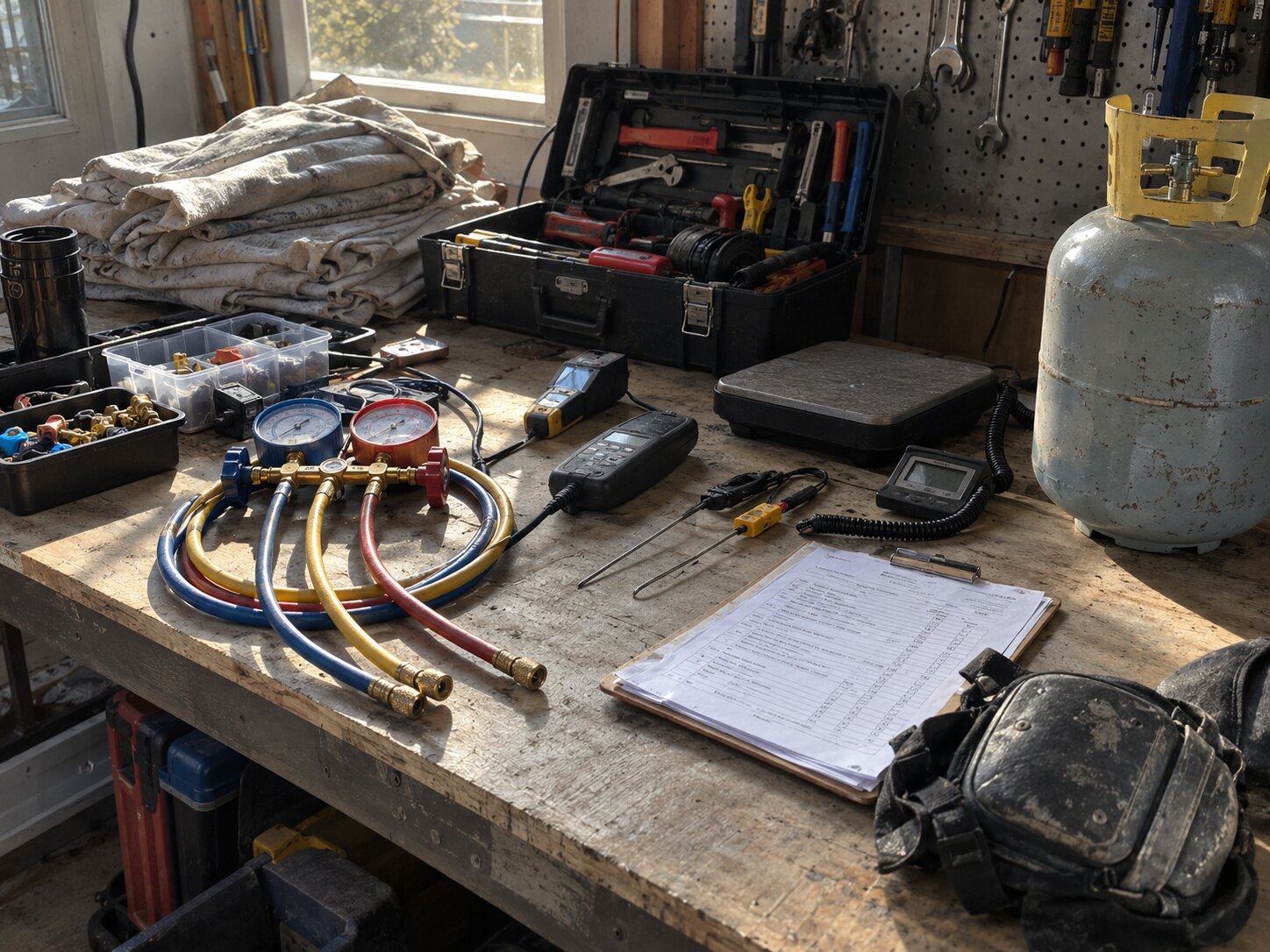
If a contractor offers to “top off your AC” without finding the leak, decline. The sentence is short and the reasoning matters. Refrigerant is not fuel; it is not consumed. A sealed air conditioning system holds the same charge it was commissioned with on day one for its entire fifteen-year life. If the system is low on refrigerant, the system has a leak. Adding more refrigerant without locating and repairing the leak does three things, all of them bad: it patches the symptom for a few weeks until the leak empties it again, it costs you money for refrigerant that’s about to vent to atmosphere, and under federal Clean Air Act Section 608 regulations, knowingly venting refrigerant is illegal. Lexington Heating and Air handles refrigerant service across Fayette County the right way: find the leak first, repair it, then recharge to the manufacturer’s exact specification by weight.
Why “Just Add Refrigerant” Is the Wrong Approach
The shortcut is tempting. Add a couple of pounds of refrigerant, the system cools again, the customer pays, the contractor leaves. Everyone is happy — until the leak that emptied the system the first time empties it again, and the customer is back where they started, out the money. Worse, running an air conditioner on a chronically low charge does measurable damage:
- The compressor (the most expensive single component, see our compressor repair page) runs hot because it isn’t getting the cooling that flowing refrigerant provides. Heat shortens its life.
- Liquid refrigerant slugging can occur when the system isn’t pumping enough vapor, sending liquid into the compressor designed only for gas.
- Each pound of vented refrigerant has measurable climate impact — R-410A has a global warming potential of around 2,088 times that of CO₂, R-22 around 1,810. The 2025 transition to R-454B (GWP ~466) is precisely about reducing this impact.
- It’s a federal violation. The Clean Air Act Section 608 prohibits the knowing venting of refrigerants, and contractors found to be doing it routinely can face EPA penalties.
Recharging without locating the leak is, in plain language, not a repair. We don’t do it.
Our Refrigerant Service Process
- Confirm low charge is the actual issue. We measure suction and discharge pressures, calculate superheat and subcooling against the manufacturer’s design values for the current outdoor temperature, and confirm low refrigerant is the real cause rather than another fault producing similar symptoms (a failing TXV, restricted airflow, or a compressor losing capacity can all mimic low charge).
- Locate the leak. We use electronic leak detection on the standard suspect points (the Schrader valves, line set connections, evaporator coil, condenser coil), and where appropriate, ultraviolet dye tracing or nitrogen pressure testing. Coil leaks — particularly formicary corrosion on copper evaporator coils — are the most common culprit on systems 5+ years old in Lexington’s humid climate.
- Repair the leak. Address the source: a brazed joint at a fitting, a Schrader valve core, sometimes a coil section, in some cases a coil replacement. Where a leak indicates a failing major component, we give you the honest repair-vs-replace picture, including the economics if the system is on R-22.
- Evacuate the system. Pull a deep vacuum to remove residual moisture and non-condensables — a step that gets skipped under shortcut work and that meaningfully affects long-term reliability.
- Recharge to specification by weight. Manufacturer charge specifications are precise. We charge by weight to the manufacturer’s exact value, then verify subcooling and superheat are within the design envelope.
- Verify performance. Confirm cooling output, dehumidification, and amp draw across the system before we leave.
What Type of Refrigerant Does Your System Use?
The refrigerant your system needs depends entirely on its age and the equipment generation:
- R-22 (HCFC-22). Found in systems installed before roughly 2010. Production and import ended in the U.S. on January 1, 2020 under the Clean Air Act phase-out. Remaining supply is reclaimed material only, and prices have climbed steeply — sometimes $100–$200 per pound for a typical residential system that takes 5–10 pounds. A significant R-22 leak is often the point where replacement makes more financial sense than recharge.
- R-410A (Puron). The dominant refrigerant for residential systems installed between approximately 2010 and 2024. Still available, though pricing has been climbing as the industry transitions away. EPA Section 608 certified handling required.
- R-454B (Opteon XL41). The lower-GWP refrigerant now standard for new equipment as of the 2025 industry transition. Classified A2L (mildly flammable), requiring specific equipment design and handling practices. Our technicians handle it.
Our EPA Section 608 Universal certified technicians handle all three legally and safely. Federal law requires certification to purchase and handle refrigerant, and the same law prohibits knowingly venting it — another reason “just topping off” without addressing leaks is, beyond being a bad repair, a regulatory violation.
Signs Your AC May Be Low on Refrigerant
- Warm or weak air from the supply registers despite the system running continuously.
- Ice or frost visible on the refrigerant lines (the larger copper line) or on the indoor evaporator coil.
- The system runs constantly but never reaches the thermostat setpoint.
- Hissing or bubbling sounds, which can indicate the leak itself.
- A noticeable rise in summer electric bills as the system struggles.
- Oily residue around line set fittings or near the evaporator coil — refrigerant carries lubricating oil, and oil at a joint usually means refrigerant is leaving with it.
Frequently Asked Questions
- Why does my AC need refrigerant if it’s a sealed system?
- It shouldn’t — and that’s the key point. Refrigerant isn’t consumed in normal operation; a sealed system keeps the same charge it was commissioned with for its entire service life. If your system is low, it has a leak. That’s why we always locate and address the leak rather than simply topping off the refrigerant, which would only empty out again.
- Can’t you just add more refrigerant?
- We can, but on its own that’s not a repair. The leak that caused the low charge will empty the system again, costing you more over time, straining the compressor, and venting refrigerant to atmosphere. The Clean Air Act Section 608 prohibits knowing venting of refrigerant, and shortcut “top-offs” without leak repair are not legally clean work. We find and fix the leak first, then recharge to specification.
- How much does a refrigerant recharge cost?
- It varies with the refrigerant type, the amount needed, and the leak repair itself. R-22 is notably expensive now — sometimes $100 to $200 per pound — because production ended in 2020 and supply is reclaimed only. R-410A and R-454B are more readily available, though R-410A pricing has been climbing during the transition. We diagnose the leak and provide a clear, itemized quote before doing the work.
- My system uses R-22 and is leaking. What are my options?
- Because R-22 production ended in 2020 and remaining supply has tightened sharply, a significant leak in an R-22 system is often the point where replacement makes more financial sense than repeated recharges. The math frequently looks like this: a major R-22 leak repair plus 5–10 pounds of refrigerant can run $1,500–$2,500, on a system likely facing other age-related failures soon. A new R-454B system with potential Section 25C tax credit eligibility starts to win on the comparison. We’ll give you the honest math.
- Is it dangerous to run my AC when it’s low on refrigerant?
- It’s risky for the equipment. A system low on refrigerant makes the compressor work harder, overheat, and potentially ingest liquid refrigerant — any of which can lead to compressor failure, the most expensive repair on an AC. If you suspect low refrigerant, especially if you see ice on the lines, turn the system off and call us to diagnose it before further damage accumulates.
Get a Proper Refrigerant Diagnosis — Not Just a Top-Off
If your AC is low on refrigerant, the leak is the real problem. We find it, fix it, and recharge to manufacturer specification by weight across Lexington and Fayette County.
- Phone: (859) 215-5241
- Address: 343 Cassidy Ave, Lexington, KY 40502
- Email: [add business email before publishing]