
Smart Thermostat Installation in Lexington, KY
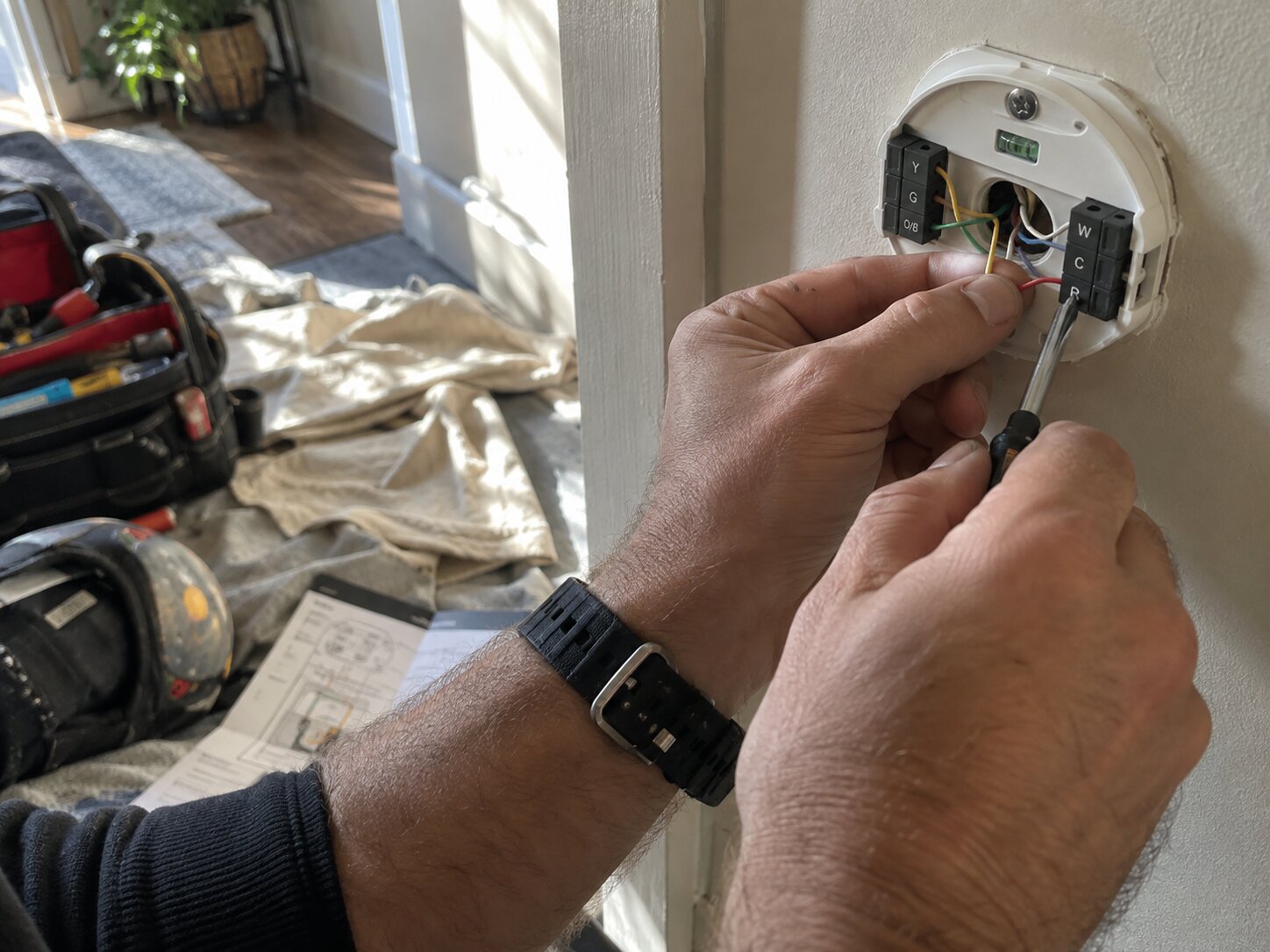
The smart thermostat industry has converged on a problem they don’t put in their advertisements: most older HVAC systems weren’t wired for them. The standard residential thermostat from twenty years ago needed two or four wires; modern smart thermostats need a constant power source (called a “C-wire” or common wire) that older installations simply didn’t include. Plug a Nest or Ecobee into a system without a C-wire and you get the symptoms homeowners spend evenings searching for online: thermostat that resets randomly, HVAC equipment that cycles when it shouldn’t, screen that goes blank, error codes that don’t make sense. The DIY install ends in frustration; the customer-support call ends in being told to hire an HVAC contractor. Lexington Heating and Air installs smart thermostats across Fayette County the way they should be installed — with the C-wire pulled where needed, the wiring labeled, the compatibility verified for the specific system, the programming walked through, and the homeowner left with a working installation rather than the half-installed flickering nightmare.
The C-Wire Problem (and Why It Matters)
Conventional thermostats from the 1980s and 1990s used the limited current available through the heating and cooling wires alone to power their basic mercury-switch or simple electronic controls. Smart thermostats have always-on screens, Wi-Fi radios, motion sensors, and processors that require a continuous power source — the C-wire (common) running from the HVAC transformer to provide 24V continuously.
Many Lexington homes — particularly those with HVAC systems installed before about 2010 — have thermostat wiring with only 4 conductors (red, white, yellow, green), no C-wire. Some smart thermostats work around this with battery power, power-stealing schemes, or external power adapters, with varying degrees of reliability. Each workaround has its own quirks. The clean solution is pulling a proper C-wire, and that’s the work we do as part of the installation.
Smart Thermostats We Install
Ecobee (Various Models)
Excellent ecosystem with strong remote sensor integration. The remote sensors let you measure temperature at multiple points in the home (bedroom, living room) rather than just at the thermostat location, which addresses some of the same problems zoning solves at a fraction of the cost. Strong dehumidification control logic relevant in Lexington’s humid climate. Good integration with Apple HomeKit and Alexa.
Google Nest (Various Models)
The most visually polished option. Learning algorithms that build a schedule from observed user behavior. Good if you don’t want to manually program a schedule. The third-generation Learning Thermostat and current Nest Thermostat have different feature sets; we install whichever fits your situation.
Honeywell Home / Resideo (Various Models)
Strong line of professional-grade smart thermostats including the T9 and T10 Pro, with sensible programming, reliable hardware, and broad HVAC system compatibility. Often the right choice for users who want smart features without the polished consumer aesthetic of Nest or Ecobee.
Other Manufacturers
Various other brands have legitimate smart thermostat offerings — Emerson Sensi, Mysa, Tado, and others — with different feature sets and price points. We install what fits your needs.
Smart Thermostat Features Worth Caring About
- Programmable schedules — the foundational smart-thermostat feature. Setbacks while you’re away or sleeping save real money over a year.
- Geofencing — the thermostat adjusts based on whether household members’ phones are home or away. Effective for households with irregular schedules.
- Remote sensors (Ecobee in particular) — reading temperature at the rooms you care about, not just where the thermostat is mounted. Addresses the upstairs-vs-downstairs problem at a fraction of the cost of zoning.
- Equipment monitoring — alerts when filters need changing, when temperature behavior is unusual, when equipment runs longer than expected.
- Voice control integration with Alexa, Google Assistant, Apple HomeKit — useful or gimmicky depending on the household.
- Energy reports — data on actual heating and cooling usage over time, often useful for understanding what affects bills.
- Utility integration — some utilities offer rebates for smart thermostat installation and demand-response participation. We can advise on what’s currently available.
The Honest Limits of Smart Thermostats
A smart thermostat is a controller, not an HVAC system. It can optimize how the existing equipment runs, but it can’t fix the underlying equipment problems. A smart thermostat won’t compensate for an oversized AC that short-cycles. It won’t fix a furnace with a failing flame sensor. It won’t make a single-zone system feel like a zoned system in a multi-floor home (though Ecobee remote sensors help). It won’t lower bills if the equipment is already running efficiently and the schedule is already optimized.
That said, for the common case — existing equipment working reasonably well, manual thermostat with no programming, occupant schedules that have setback opportunities — a smart thermostat with a properly configured schedule typically saves 8–15% on heating and cooling costs, per Energy Star estimates. The math works most strongly for households that have setback opportunities they’re not currently using.
The Installation Process
- Compatibility verification. Not every smart thermostat works with every HVAC system. Heat pumps, multi-stage equipment, dual-fuel systems, and some older configurations have specific compatibility requirements. We verify before purchase rather than after.
- Existing wiring inspection. What wires are currently at the thermostat, what’s labeled correctly, what’s not.
- C-wire installation if needed — pulling a new conductor from the HVAC unit to the thermostat location, which can be straightforward in some homes and require fishing through walls in others.
- Existing thermostat removal. Mercury switch thermostats (still common in older Lexington homes) require careful handling for proper disposal.
- New thermostat mounting with the wall plate, level, and ready for connections.
- Wiring connections with each wire labeled correctly, photographed for reference, and connected per the system configuration.
- System configuration in the thermostat — equipment type (gas furnace, heat pump, dual-fuel), staging (single-stage, two-stage, variable), accessories (humidifier, dehumidifier, ventilator), and zone settings if applicable.
- Wi-Fi setup with your home network, including the app configuration on your phone.
- Programming the initial schedule based on your typical occupancy patterns.
- Testing each operating mode — heating call, cooling call, fan call, auxiliary heat if heat pump, accessories if installed — verifying each functions correctly.
- Walkthrough on operation, remote access, schedule adjustments, and what to expect.
Frequently Asked Questions
- Do I need a C-wire for a smart thermostat?
- Most smart thermostats need a continuous power source (C-wire), and many older Lexington homes don’t have one in the existing thermostat wiring. Some thermostats include workarounds like battery power or power-stealing schemes, but the reliable solution is pulling a proper C-wire as part of the installation. We do that work as needed.
- Will a smart thermostat actually save me money?
- For most households, yes — typically 8 to 15 percent on heating and cooling costs per Energy Star estimates, when the schedule is properly configured to take advantage of setback opportunities. Households that already use manual setbacks aggressively may see smaller savings; households that previously kept the thermostat at a fixed temperature 24/7 typically see the largest improvements. The math is strongest for irregular schedules where geofencing helps.
- Which smart thermostat should I choose?
- It depends on your priorities. Ecobee’s remote-sensor capability is genuinely useful in multi-floor homes. Nest’s learning algorithms reduce the manual programming burden. Honeywell’s Home/Resideo line offers professional-grade reliability without the consumer aesthetic. We discuss your situation and recommend honestly, without pushing a specific brand because of margin.
- Can I install a smart thermostat myself?
- For homes with existing C-wires and standard single-stage equipment, yes — many homeowners install their own thermostats successfully. The complications come with C-wire-less wiring, heat pumps, multi-stage equipment, dual-fuel systems, and accessories like humidifiers or dehumidifiers wired into the thermostat. If the DIY install becomes frustrating, we’re happy to finish it.
- What if I have a heat pump or dual-fuel system?
- Heat pump and dual-fuel systems have specific compatibility and configuration requirements that most general-purpose smart thermostats can accommodate but require correct setup. Auxiliary heat staging, crossover temperatures, and dual-fuel switching logic all need to be configured correctly — misconfiguration can either run electric resistance heat unnecessarily (expensive) or fail to bring in backup heat when needed (uncomfortable). We configure these specifically based on your equipment.
Schedule a Smart Thermostat Installation
The work starts with confirming compatibility for your specific HVAC equipment, then handles the C-wire pull if your wiring needs one, then configures the staging, accessory wiring, and dual-fuel logic before the homeowner walkthrough on schedules and remote access. The thermostat works the way it’s supposed to from day one rather than being a project you finish over weekends.
- Phone: (859) 215-5241
- Address: 343 Cassidy Ave, Lexington, KY 40502
- Email: [add business email before publishing]