
Emergency HVAC in Wilmore, KY: After the Storm, the AC Won’t Start, Start to Finish
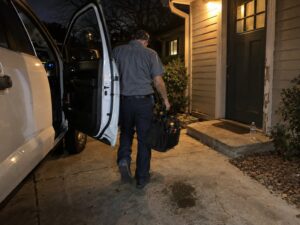
A composite drawn from the emergency calls we run across Jessamine County. The triage, diagnostics, and decisions are real to how we work; the customer name, exact address, and dollar figures are left out for privacy. This isn’t a customer testimonial — see our testimonials page for actual reviews.
Central Kentucky summers bring fast, violent thunderstorms, and the call that follows isn’t always storm damage you can see — it’s the AC that won’t restart after the power flickered or surged. When the grid blinks during a storm, the voltage spike or the hard restart can take out electrical components in an outdoor unit, and the house starts heating up in the humid aftermath. A homeowner near Wilmore calls the morning after a line of storms: the power’s back, but the AC is dead, and it’s already getting warm and sticky inside. Here’s how that call goes.
The Scenario
An evening line of thunderstorms moved through Jessamine County with the usual flickering power and at least one hard outage. By the next morning the power is restored across Wilmore, but the homeowner’s AC won’t run — the thermostat calls, but the outdoor unit is silent. It’s a humid post-storm day climbing toward the upper 80s, and the house is warming. The system is a serviceable R-410A split system that was working fine before the storm.
The Triage Conversation
Emergency triage after a storm weighs the conditions and the household, and storm days often bring a queue of similar calls. The triage on this one:
- Urgency questions: Vulnerable household members? How hot is it getting inside, and how fast? Any signs of storm damage — a tree limb on the unit, visible burning, or a burning smell — versus simply not starting?
- Safety screen. If there were any burning smell, smoke, or visible electrical damage, that changes the response — shut it off at the breaker and treat it as a potential electrical hazard. Here, the unit was simply dead with no damage signs.
- Quick checks by phone. Confirmed the thermostat was set to cool and calling, and walked the homeowner through checking whether the breaker for the AC had tripped during the surge and whether the outdoor disconnect was seated — storm power events commonly trip these, and resetting sometimes restores the system. This time it didn’t.
- Honest time estimate. Storm mornings stack up calls; we quoted a realistic arrival window for the run down to Wilmore rather than a number we couldn’t hit, and confirmed the household could stay safe within it, with vulnerable-household and genuine-safety calls prioritized.
What We Did on Arrival
An outdoor unit that’s dead after a power surge points at the electrical components first. The diagnostic process:
- Safe inspection. Confirmed no storm damage, burning, or hazard at the unit before working on it.
- Power and disconnect check. Verified voltage to the unit and the disconnect, confirming the surge hadn’t simply left it without power.
- Contactor inspection. Checked the contactor — the electrically operated switch that powers the compressor and fan — for surge damage, pitting, or a coil that no longer pulls in.
- Capacitor test. Measured the dual-run capacitor, a component commonly damaged by voltage spikes.
- Control and low-voltage check. Verified the low-voltage circuit and confirmed no further surge damage to controls before returning the system to service.
- Refrigerant pressures verified once running, to confirm the system was otherwise healthy.
- Documentation of the findings.
What We Found
The storm’s power surge had damaged the contactor and the run capacitor — the contactor’s contacts were pitted and not reliably closing, and the capacitor measured well below its rating. Together they kept the outdoor unit from starting. The compressor itself checked out healthy once it could run. The fix was replacing the damaged contactor and capacitor, then verifying nothing else had been harmed by the spike.
The Repair
- Powered down the unit at the disconnect and safely discharged the capacitor.
- Replaced the surge-damaged contactor with a correctly rated part.
- Installed a correctly rated replacement dual-run capacitor.
- Inspected the remaining controls for surge damage before restoring power.
- Restored power and confirmed the compressor and fan started and ran normally.
- Verified refrigerant pressures and the temperature drop across the coil, and confirmed indoor temperature was falling before leaving.
The Outcome
Cooling was restored that day with two inexpensive electrical parts, and the house recovered before the post-storm heat became a problem. Because the surge damage was caught and the rest of the controls checked, the homeowner didn’t end up running a partially-damaged system into a bigger failure. We mentioned, without pressure, that whole-home or HVAC surge protection can reduce the odds of this happening in the next storm — a reasonable add for a home that’s seen surge damage once.
What Made This a Real Emergency
- Post-storm heat and humidity with a house warming and no cooling, especially with vulnerable occupants.
- No quick reset fix — the breaker and disconnect checks didn’t restore it, so it needed a technician.
- Possible hidden surge damage — running a surge-affected system without checking it risks compounding the failure.
What Wouldn’t Be a Real Emergency
The same situation under milder conditions usually doesn’t justify after-hours rates:
- A mild post-storm day with a healthy household, where waiting for next-available is safe.
- An AC that turns out to have only a tripped breaker or unseated disconnect, which the homeowner can often reset (once, safely; repeated tripping needs diagnosis).
- Cosmetic concerns with the unit still cooling normally.
We’ll tell you honestly when your situation can safely wait, even when that means standard-rate revenue rather than an after-hours premium.
Pricing Framework
Emergency call costs in Wilmore typically combine an after-hours dispatch fee with standard diagnostic and repair charges; surge-damaged electrical parts are usually on the inexpensive end, but the diagnosis must rule out hidden damage. We quote the diagnostic charge upfront when you call, and the run from our Lexington base down to Wilmore is factored into the honest arrival window.
Frequently Asked Questions
- Is this a real customer’s project?
- It’s a composite built from the emergency calls we run in Wilmore and across Jessamine County, not one named customer’s account. The triage, diagnostics, and outcomes are accurate to how we actually work; the name, address, and figures are left out for privacy. For real customer reviews, see our testimonials page.
- My AC died after a storm. What should I check first?
- Confirm the thermostat is set to cool and calling, then check whether the breaker for the AC tripped during the power event and whether the outdoor disconnect is seated. Storm surges and outages commonly trip these, and a reset sometimes restores the system. If it trips again, or there’s any burning smell or visible damage, leave it off and call — that needs a technician.
- Can a power surge really damage my AC?
- Yes. Voltage spikes and hard restarts during storms commonly damage electrical components like the contactor and run capacitor, and sometimes control boards. Those are often inexpensive to replace, but it’s important to check for hidden damage before running the system, so a small problem doesn’t become a big one.
- Is it an emergency, or can it wait?
- It depends on the heat and who’s home. On a hot, humid post-storm day, or with vulnerable occupants, a dead AC is genuinely urgent. On a mild day with a healthy household it can usually wait for next-available. We’ll triage honestly on the phone and tell you which it is.
- Can I prevent surge damage next time?
- Whole-home or dedicated HVAC surge protection can reduce the risk of this kind of storm damage. It’s a reasonable addition for a home that’s already had a surge take out AC components, and we’re happy to discuss options.
Call When the Situation Warrants It
If a storm has left your AC dead in Wilmore or anywhere in Jessamine County, call and we’ll triage on the phone — walk you through the safe resets to try, tell you whether it’s a real emergency, give you the realistic arrival window from Lexington, and prioritize vulnerable-household and genuine-safety calls. No turning routine repairs into emergencies.
- Phone: (859) 215-5241
- Address: 343 Cassidy Ave, Lexington, KY 40502