
Air Filter Replacement in Lexington, KY
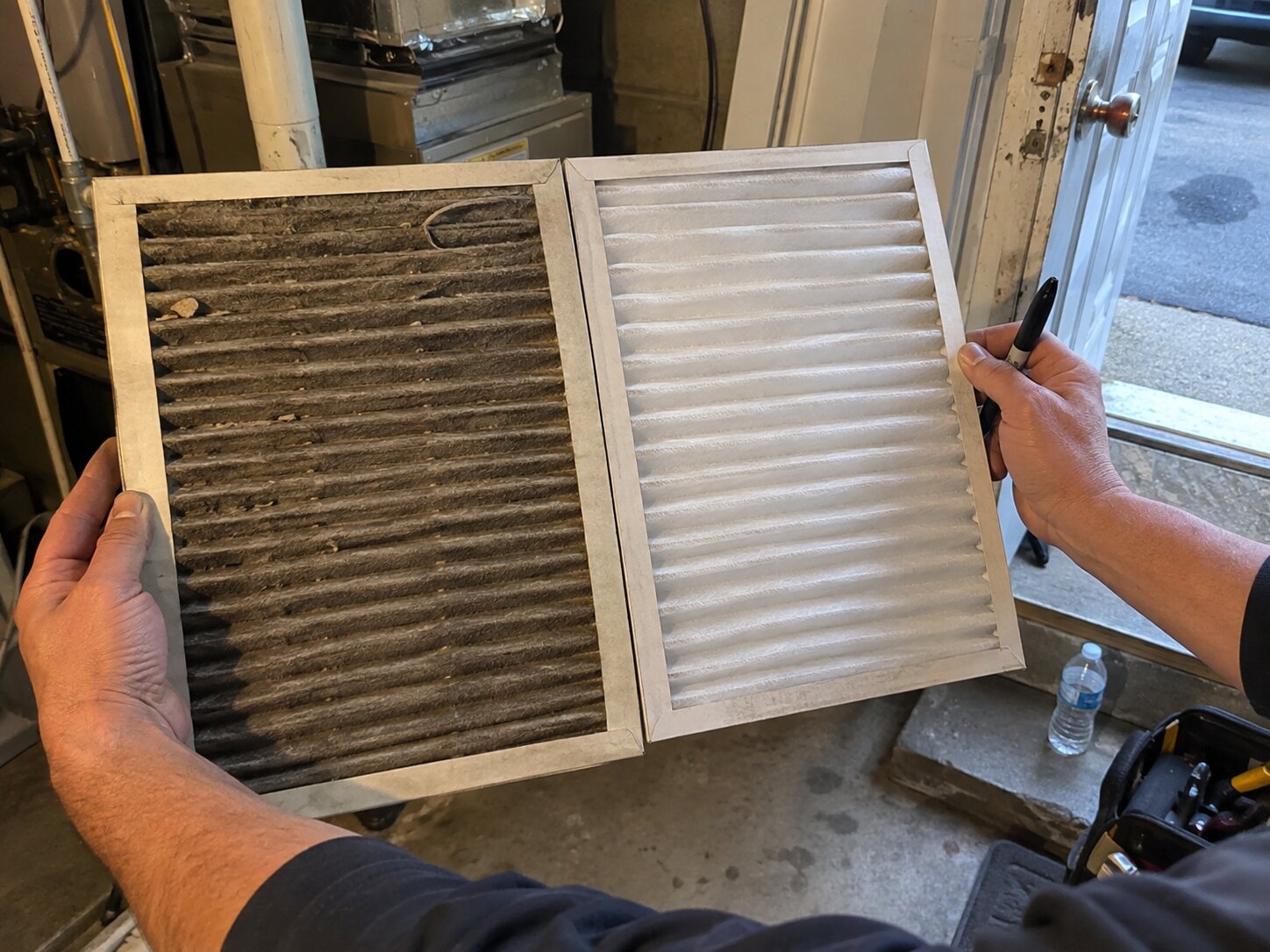
The air filter is the cheapest piece of HVAC maintenance, the most frequently neglected, and the one whose neglect causes the largest fraction of downstream problems. A clogged filter doesn’t just stop catching dust — it restricts airflow across the system, raises static pressure on the blower motor, drops the evaporator coil temperature to the point of freezing in cooling season, makes the furnace overheat and trip on high limit in heating season, and forces every component downstream to work harder for the same output. We see this pattern every week. Lexington Heating and Air handles air filter service across Fayette County the way it deserves to be done: by helping you understand which filter is right for your specific system, what schedule works for your home, and how to avoid the surprisingly easy mistake of upgrading to a filter your equipment can’t tolerate.
Why Air Filters Matter More Than People Think
Every air filter does two distinct jobs, and they’re sometimes in tension. The first is protecting the HVAC equipment from dust and debris that would otherwise foul the blower wheel, accumulate on the evaporator coil, and degrade the components inside the air handler. The second is improving indoor air quality by removing airborne particulates from the air circulating through your home. A 1-inch fiberglass filter at MERV 2 does the first job adequately and barely attempts the second. A MERV 13 media filter does both, at the cost of higher airflow restriction. The right filter for your system is the one that does both jobs as well as your equipment can support.
The Real Costs of a Clogged Filter
- Reduced airflow. A clogged filter is, mechanically, exactly the same problem as a closed register or a collapsed duct: restricted air movement that the blower has to fight against.
- Frozen evaporator coil in summer. Restricted airflow drops coil temperature below freezing; ice accumulates; cooling stops. This is one of the most common emergency cooling calls in central Kentucky — almost always traceable to a filter that was supposed to be changed two months ago.
- Overheating furnace in winter. Restricted return airflow causes the heat exchanger to overheat, tripping the high-limit safety switch and cycling the furnace off mid-cycle. Repeated overheating accelerates heat exchanger fatigue.
- Higher energy bills. The blower draws more current to push air against the restriction, and reduced heat transfer at the coil makes everything less efficient.
- Shortened equipment life. Repeated overheating, frozen coils, and elevated blower amperage all shorten the lifespan of components designed for design-condition airflow.
- IAQ degradation. A loaded filter that’s bypassed (air finding a way around it through gaps in the housing) can actually return contaminants to the supply stream that it caught earlier.
MERV Ratings: What They Mean and Which to Pick
MERV stands for Minimum Efficiency Reporting Value, the industry-standard rating for residential air filters. The scale runs from 1 to 16 for residential filters, with higher numbers catching smaller particles. Practical breakpoints:
- MERV 1–4. Basic protection for the equipment. Catches large dust and pollen, fibers, and visible debris. Most disposable fiberglass filters sit here. Inadequate for indoor air quality but minimal airflow restriction.
- MERV 5–8. The mid-tier where most pleated 1-inch filters land. Catches mold spores, hair spray, larger dust mite debris. Reasonable balance of filtration and airflow.
- MERV 9–12. Catches Legionella, finer dust, automobile emissions, lead and welding fume particulates. Most allergy-rated 1-inch filters claim this range, though many achieve it only when new and load up quickly.
- MERV 13. The level CDC and ASHRAE endorse as a meaningful IAQ upgrade. Catches bacteria-sized particles, mold spores, and the larger respiratory droplets that carry viruses. Most residential systems struggle with MERV 13 in a 1-inch form factor; a 4 to 5-inch media filter housing handles it without airflow penalty.
- MERV 14–16. Approaches HEPA territory. Often found in commercial applications and specialty residential systems with adequate blower capacity.
The 1-Inch vs. 4–5-Inch Media Filter Question
This is one of the most useful upgrades available on most residential HVAC systems. A 1-inch filter has limited surface area, which means restriction climbs quickly as the filter loads with dust, and high MERV ratings in that form factor often choke the system. A 4 to 5-inch media filter has roughly five times the surface area for the same face dimensions, which means:
- Higher MERV ratings (typically MERV 11 or 13) with less restriction than a comparable 1-inch filter.
- Much longer service life — typically 6 to 12 months between changes versus 1 to 3 months for a 1-inch filter.
- Lower lifetime cost despite higher per-filter price.
- Less frequent maintenance.
The catch: media filter housings require space at the air handler return. Not every installation has it. We measure the system and assess whether a media filter housing is feasible — it usually is, often with minor modifications.
How Often to Change Your Filter
Recommendations vary because the right interval depends on the filter type, your home, and your usage:
- 1-inch fiberglass (MERV 1–4): Every 30–60 days. These load quickly and have minimal capacity.
- 1-inch pleated (MERV 5–8): Every 60–90 days for most homes; more frequently with multiple pets, smokers, or new-construction dust.
- 1-inch higher-MERV (9–12): Every 30–60 days because the restriction climbs faster as they load. We’re often skeptical of these in 1-inch form factor.
- 4–5-inch media filter (MERV 8–13): Every 6–12 months for most homes. Sometimes longer in clean, low-occupancy applications; sometimes shorter in heavy-pet or high-traffic homes.
- Electronic air cleaner cells: Clean monthly to maintain performance (the maintenance step most homeowners skip, undermining the technology).
The visual test: when you can no longer see light through the filter held to a window, the filter is overloaded regardless of what the calendar says.
Common Filter Mistakes We See
- Upgrading MERV without considering airflow. A homeowner buys a “premium” MERV 13 1-inch filter for a system designed for MERV 8, then can’t understand why the coil keeps freezing or the furnace keeps tripping on high limit. Match the filter to the system, or upgrade the system to handle the filter.
- Wrong size. A filter that doesn’t fit snugly lets air bypass around it. Many homes have non-standard filter housing sizes that require custom-cut filters; using a near-fit size that’s too small is worse than using a lower MERV filter that fits correctly.
- Installed backward. Filters have a directional arrow showing the airflow direction. Installed backward, the filter still catches particles but the structure isn’t supported as designed, and capacity drops.
- Forgetting it exists. The most common mistake by far. Set a calendar reminder or sign up for a maintenance plan that includes filter changes.
- Buying the cheapest filter for an expensive system. Penny-wise on filtration is usually pound-foolish on equipment life and IAQ.
Frequently Asked Questions
- How often should I change my HVAC filter?
- It depends on the filter type. Standard 1-inch fiberglass filters every 30 to 60 days. Pleated 1-inch MERV 8 filters every 60 to 90 days for most homes. Higher-MERV 1-inch filters every 30 to 60 days because restriction climbs faster. Thicker 4 to 5-inch media filters typically last 6 to 12 months. Pets, smokers, allergies, and high-traffic homes all push toward more frequent changes regardless of filter type.
- What MERV rating should I use?
- For most Lexington homes with standard equipment, MERV 8 to 11 in a 1-inch format strikes the right balance between filtration and airflow. If you want MERV 13 (the CDC and ASHRAE endorsement for IAQ), the better path is upgrading to a 4 to 5-inch media filter housing that handles the higher rating without the airflow penalty. We measure your system’s static pressure tolerance before recommending an upgrade.
- Can a clogged filter really damage my AC or furnace?
- Yes, and we see it routinely. A clogged filter restricts airflow, which causes the evaporator coil to freeze in summer and the heat exchanger to overheat in winter. Both shorten equipment life. The frozen-coil pattern in particular is responsible for a meaningful share of emergency cooling calls in central Kentucky each summer. A $15 filter change can prevent a $150 emergency service call — or a $3,000 coil replacement.
- Are washable / reusable filters worth it?
- For most homes, no, particularly in our humid climate. Reusable filters typically have lower MERV ratings than disposable equivalents, require thorough drying before reinstallation (a damp filter introduces moisture and microbial growth into the system), and the maintenance hassle is real. There are specialty applications where reusable filters make sense, but the typical homeowner is better served by a disposable pleated filter on a regular schedule.
- Should I subscribe to a filter delivery service?
- If it makes you actually change the filter on schedule, yes. The filters from subscription services aren’t usually special — you can buy the same filters at hardware stores — but the calendar reminder and the delivery to your door is genuinely useful for the maintenance most homeowners skip. Alternatively, a maintenance plan with us typically includes filter service.
Schedule Filter Service or an Upgrade Assessment
A $15 filter change prevents a $150 emergency call or a $3,000 coil replacement — if it actually happens on schedule. A media filter housing upgrade pays for itself in service-life extension on equipment and IAQ benefit. Call to set up either, across Lexington and Fayette County.
- Phone: (859) 215-5241
- Address: 343 Cassidy Ave, Lexington, KY 40502
- Email: [add business email before publishing]