
Whole-Home Air Purifiers in Lexington, KY
The category “air purifier” hides a wide spectrum of technologies, from genuinely effective mechanical filtration to marketing products with questionable evidence. A homeowner shopping for whole-home air cleaning faces a confusing landscape: MERV ratings, HEPA, electronic air cleaners, ionizers, photocatalytic oxidation (PCO), bipolar ionization, ozone generators. Some of these work. Some work but produce byproducts you don’t want. Some don’t work meaningfully despite confident marketing claims. Lexington Heating and Air installs whole-home air purification across Fayette County, and we’ll be honest about what each technology actually does, what evidence supports it, and what your home likely needs — rather than selling whatever has the highest margin this quarter.
The Technology Landscape, Honestly
Mechanical Filtration (Strong Evidence, What We Usually Recommend)
Mechanical filters catch particles by physically trapping them in the filter media. The technology is well-understood, the performance is measurable, and the science is settled. The relevant rating systems:
- MERV (Minimum Efficiency Reporting Value). Industry standard 1–16 rating for residential filters. MERV 8 catches dust and pollen reasonably well; MERV 11 adds pet dander and fine particulate; MERV 13 catches bacteria-sized particles, mold spores, and most virus-carrying respiratory droplets. The CDC and ASHRAE both endorse MERV 13 as a meaningful upgrade for indoor air quality.
- HEPA (High Efficiency Particulate Air). A separate standard requiring 99.97% removal of 0.3-micrometer particles. Equivalent to roughly MERV 17–20. Used in surgical suites and cleanrooms; in homes, only practical in dedicated standalone units or carefully designed whole-home systems because of the airflow restriction.
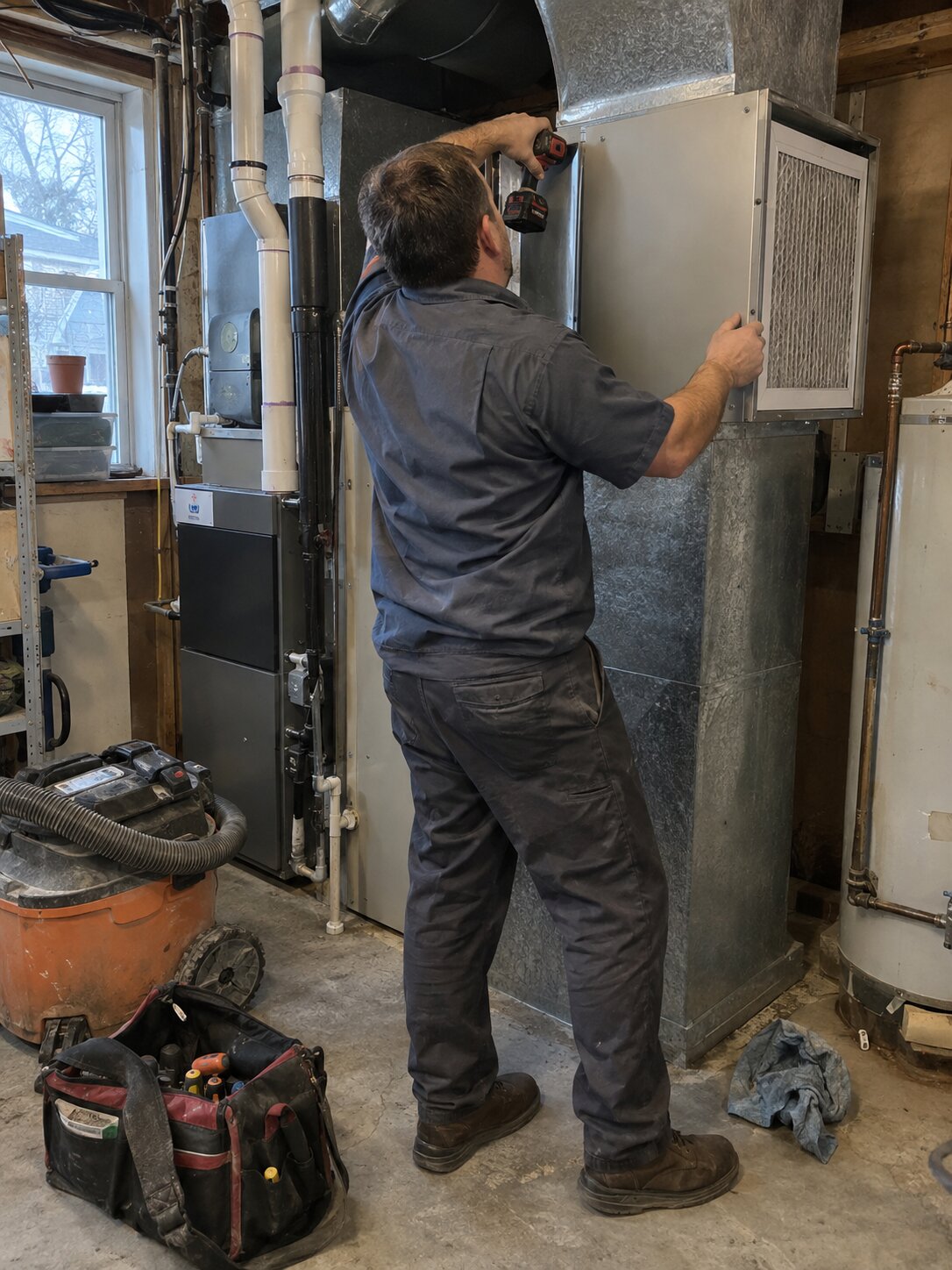
The tradeoff with mechanical filtration is airflow. Higher MERV media is denser, restricts more airflow, and raises static pressure across the air handler. A system designed for MERV 8 can suffer reduced efficiency, blower strain, or coil freezing if a MERV 13 filter is dropped in without other changes. The right approach is upgrading to a media filter housing (4 to 5-inch thick filter with much more surface area) that handles higher MERV without the restriction penalty. We measure static pressure as part of any upgrade.
Electronic Air Cleaners (Mixed)
Electronic air cleaners (sometimes called electrostatic precipitators) electrically charge particles in the airstream and collect them on oppositely charged plates. When clean and properly maintained, they can match or exceed MERV 13 performance on particle removal. The catch: the collector plates require regular cleaning — failure to clean reduces performance dramatically, and most homeowners don’t keep up with it. Some older designs also produced trace ozone as a byproduct; modern designs largely don’t, but it’s worth confirming the specific model. Honest assessment: works well if you commit to the maintenance.
UV-C at the Evaporator Coil (Strong Evidence, Specific Application)
UV-C lamps mounted to shine on the wet evaporator coil during cooling season suppress mold and biofilm growth on the coil surfaces. Solid science: UV-C disrupts microbial DNA at sufficient exposure, and a stationary lamp shining on a stationary coil for hours per cycle delivers the dose needed. Particularly relevant in our humid climate where coils stay wet for months. See our UV light treatment page for more.
In-Duct UV for Air Sterilization (Weaker Evidence)
UV lamps installed to sterilize air as it passes through the duct face a different physics problem: air moves through the lamp’s exposure zone in fractions of a second, and the UV dose delivered to airborne particles in that brief exposure is much lower than the dose delivered to surfaces. For ductless in-duct sterilization claims, the evidence is mixed; for the same money, MERV 13 mechanical filtration typically delivers more measurable benefit. We’re honest about this rather than selling both.
Photocatalytic Oxidation (PCO) and Bipolar Ionization (Contested)
These technologies claim to neutralize particles, VOCs, and pathogens through chemical reactions in the airstream rather than mechanical filtration. The marketing is impressive. The peer-reviewed evidence is mixed at best, and several investigations have raised concerns about byproduct formation (formaldehyde from some PCO systems, ozone from some ionizers). Major scientific organizations have been measured in their recommendations, often noting that mechanical filtration achieves the goals with better-understood performance and fewer questions. We’re skeptical of these products, and we don’t push them.
Ozone Generators (Avoid)
Ozone generators are sometimes marketed as air purifiers. They’re not, in any honest sense. Ozone at the concentrations needed to oxidize indoor air pollutants is itself a respiratory irritant and lung damaging agent. The EPA explicitly warns against using ozone generators in occupied spaces. We do not install them.
What Most Lexington Homes Actually Need
For the large majority of central Kentucky homes asking about air purification, the right answer is a media filter housing with a MERV 11–13 filter, paired with a clean evaporator coil and proper humidity control. That combination addresses particulate filtration with proven technology, doesn’t introduce byproduct concerns, doesn’t require ongoing maintenance failures to undermine performance, and costs a fraction of the high-end whole-home systems. The marketing-heavy products at the top end have a place — specific allergy situations, immunocompromised household members, post-renovation dust, certain pet allergen scenarios — but they aren’t necessary for most homes.
When Higher-End Purification Genuinely Helps
- Documented allergies to specific particles — particularly pollen, mold spores, or pet dander — that affect a household member significantly.
- Asthma or other respiratory conditions where particle reduction provides measurable symptom relief.
- Immunocompromised household members for whom airborne pathogen reduction has real medical value.
- Active construction or renovation generating substantial dust.
- Demonstrated indoor mold or microbial contamination being addressed comprehensively (remediation first, then ongoing filtration).
- Multi-pet households where dander accumulation is a measurable issue.
How We Approach an Air Purification Recommendation
- Understand the actual problem. What symptom or concern brought you to consider air purification? Dust visible on surfaces? Allergy symptoms? Odors? Specific pollutants? Each points to a different solution.
- Measure the system. Static pressure across the existing air handler, current filter restriction, blower capacity, coil condition. This determines what level of filtration upgrade is feasible without harming the equipment.
- Recommend honestly. Often the right answer is a media filter housing upgrade, sometimes paired with coil-targeted UV-C. Sometimes the right answer is addressing the source of the problem (a damp basement, a pet bedding situation, an outdoor air infiltration path) before filtering symptoms.
- Install correctly. Media filter housing, transitions, gasketing, and seal verified. Improperly sealed filter housings let air bypass the filter, undermining performance.
- Verify performance. Static pressure measured post-installation, airflow verified, system commissioned.
Frequently Asked Questions
- What’s the difference between a regular filter, MERV 13, and HEPA?
- A standard 1-inch fiberglass filter (often MERV 1 to 4) is designed primarily to protect HVAC equipment, not to clean the air. MERV 13 catches bacteria-sized particles, mold spores, and most virus-carrying respiratory droplets and is endorsed by CDC and ASHRAE as a meaningful IAQ upgrade. HEPA filters 99.97% of 0.3-micrometer particles and is the standard in surgical and clean room applications. The trade-off across the spectrum is airflow restriction, which is why upgrading often requires a media filter housing rather than just a higher-MERV 1-inch filter.
- Do whole-home air purifiers actually work?
- Mechanical filtration (MERV 11, MERV 13, HEPA) works as advertised when properly sized for the system and the filter housing is sealed correctly. Electronic air cleaners work when properly maintained. UV-C targeted at the evaporator coil works for biofilm suppression. Other technologies (photocatalytic oxidation, bipolar ionization, ozone) have mixed or negative evidence, and we don’t push them. We focus on what’s proven to work for your specific situation.
- Will an air purifier help my allergies?
- Often yes, for the right kind of allergens. Pollen, mold spores, pet dander, and dust particles are reduced meaningfully by MERV 11 or higher mechanical filtration. The benefit is larger when the home is reasonably sealed (the filter has to actually capture air passing through the HVAC system, so a home where the AC barely runs sees less filtration). Allergies driven by sources other than airborne particles, like ingested allergens or contact allergens, aren’t addressed by air purification.
- Why shouldn’t I just put a MERV 13 filter in my existing system?
- You can try, but a system designed for a MERV 8 filter may not have enough blower capacity for the increased restriction of MERV 13 in a 1-inch form factor. The result can be reduced airflow, coil freezing, blower strain, and reduced efficiency. The right approach is upgrading to a media filter housing, which has much more surface area for the same MERV rating, lower static pressure penalty, and longer service life. We measure your system before recommending an upgrade.
- What about ionizers and UV air sterilizers I see advertised?
- We’re skeptical of in-duct ionization, photocatalytic oxidation, and air-sterilization UV claims. The peer-reviewed evidence is mixed, some products have produced unintended byproducts like ozone or formaldehyde, and the same dollars spent on proven mechanical filtration typically deliver more measurable benefit. Coil-targeted UV-C for biofilm suppression is different and has solid evidence. We’re happy to discuss specific products honestly rather than push whatever has the best margin.
Get an Honest Air Purification Recommendation
Skip the marketing-heavy products. We assess your home, identify the actual problem, and recommend proven solutions matched to it. Across Lexington and Fayette County.
- Phone: (859) 215-5241
- Address: 343 Cassidy Ave, Lexington, KY 40502
- Email: [add business email before publishing]