
AC Repair in Wilmore, KY: A Safety Switch Did Its Job, Start to Finish
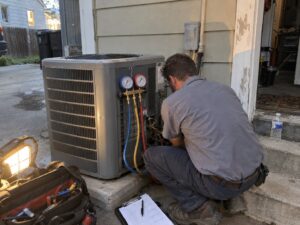
A composite drawn from the AC repair calls we run across Jessamine County. The diagnostics, decisions, and outcomes are real to how we work; the customer name, exact address, and dollar figures are left out for privacy. This isn’t a customer testimonial — see our testimonials page for actual reviews.
Plenty of the older homes around Asbury and Wilmore’s Main Street district have their air handler tucked in an attic or a closet, and that placement makes one common AC failure more important than it sounds: a clogged condensate drain. When the drain backs up, a float safety switch shuts the system off on purpose — not because the AC is broken, but to keep condensate from overflowing and staining ceilings or warping floors in a house worth protecting. A homeowner near campus calls because the AC has simply stopped, with no obvious cause. Here’s the diagnosis, which is as much about preventing water damage as restoring cooling.
The Scenario
An older two-story near downtown Wilmore, roughly 1,800 square feet, with the air handler in the attic. On a humid summer afternoon the system has stopped cooling entirely — not weak, just off — and the thermostat is calling with no response. There may be a little water staining near the unit. The equipment is a serviceable R-410A split system in otherwise good shape.
What We Did on the Assessment
A system that’s completely dead on a cooling call — rather than running poorly — points at a control or safety interruption rather than a refrigerant problem. The diagnostic process:
- Control and power check. Confirmed the thermostat was calling and that power was present, then looked for what was interrupting the call to the equipment.
- Float safety switch inspection. Found the condensate float switch tripped — it interrupts the system when water backs up, exactly as designed. That explained the dead system.
- Condensate drain inspection. Traced the drain line and the drain pan; the primary drain was clogged with the algae and biofilm that build up over seasons, backing water up to the switch.
- Pan and overflow check. Inspected the drain pan and any secondary pan, since attic air handlers rely on these to protect the ceiling below.
- Refrigerant and airflow verification once the system could run, to confirm nothing else was wrong behind the shutoff.
- Documentation of the findings before quoting.
What We Found
The AC wasn’t broken — the condensate float switch had shut it down to prevent an overflow, because the primary drain line was clogged. The switch did precisely what it’s there for: trading a temporary loss of cooling for protection against water damage to the home. The fix was clearing the drain and resetting the system, not a refrigerant or component repair.
The Repair Work
Performed same day:
- Cleared the clogged condensate drain line, flushing the algae and biofilm buildup and confirming free flow.
- Cleaned the drain pan and verified the secondary/overflow protection was intact for the attic location.
- Confirmed the float switch reset and the system resumed normal operation.
- Verified refrigerant pressures and the temperature drop across the coil to confirm full cooling once running.
- Recommended a drain treatment and an annual check, since attic and closet air handlers benefit most from keeping the drain clear.
- Walked the homeowner through what the switch did and why, so a future shutoff isn’t a mystery.
The Outcome
Cooling was restored the same day with an inexpensive drain clearing, and — just as importantly in an older home — no water damage to the ceiling below the attic unit, because the safety switch caught it. We left the homeowner with a simple maintenance habit that prevents most repeat calls of this kind.
Where Your Situation Might Differ
- A system that runs but cools weakly points elsewhere — a refrigerant issue, a frozen coil, or a capacitor or contactor fault — not a tripped float switch.
- If the drain pan or secondary protection has already overflowed, there may be water remediation to address alongside the AC repair.
- A failed (rather than tripped) float switch needs replacement.
- Closet and attic air handlers are more prone to drain-related shutoffs than basement units, which often drain by gravity to a nearby floor drain.
Pricing Framework
Specific dollars vary with the cause and any water cleanup involved, so rather than a number that won’t match your situation, here’s how AC repair costs in Wilmore tend to fall:
- Inexpensive repairs — condensate drain clearing, float switch reset or replacement, capacitor or contactor replacement, basic thermostat replacement.
- Mid-range repairs — blower motor replacement, evaporator coil replacement, refrigerant leak repair with recharge.
- High-cost repairs that often push toward replacement — compressor failure on older equipment, multiple-component failures, R-22 systems needing refrigerant.
Diagnostic charges are quoted upfront when you call, so you know the cost before we arrive.
Frequently Asked Questions
- Is this a real customer’s project?
- It’s a composite built from the AC repair work we do regularly in Wilmore and across Jessamine County, not one named customer’s account. The diagnostics, decision points, and outcomes are accurate to how we actually work; the name, address, and figures are left out for privacy. For real customer reviews, see our testimonials page.
- My AC just stopped completely. What does that usually mean?
- A system that’s fully off on a cooling call (rather than running weakly) often points to a control or safety interruption — commonly a tripped condensate float switch, a thermostat issue, or a tripped breaker — rather than a refrigerant problem. With attic or closet air handlers, a clogged condensate drain tripping the float switch is one of the most common causes.
- Why would a switch shut my AC off on purpose?
- The condensate float switch is a safety device. When the drain backs up, it shuts the system down to stop water from overflowing and damaging ceilings and floors. In an older home that’s a feature, not a fault — it trades a little lost cooling for protection against an expensive water problem.
- How do I prevent this from happening again?
- Keep the condensate drain clear. A periodic drain treatment and an annual check, especially for attic and closet air handlers, prevents most of these shutoffs. We’ll show you what to watch for and can include it in routine maintenance.
- Do you handle permits in Wilmore?
- A repair like this doesn’t require a permit. For installations and major work inside the city, permits go through the City of Wilmore; for properties outside the city limits, through Jessamine County. We handle the permitting on work that needs it.
Schedule an AC Repair Assessment in Wilmore
If your AC has stopped cold with no obvious cause — especially with the air handler in an attic or closet — get in touch and we’ll find out why and protect the house in the process.
- Phone: (859) 215-5241
- Address: 343 Cassidy Ave, Lexington, KY 40502