Furnace Repair in Wilmore, KY: It Lights, But No Heat Comes Out, Start to Finish
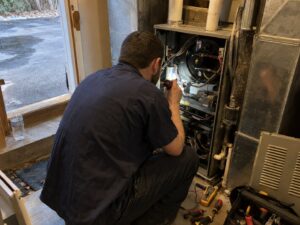
A composite drawn from the furnace repair calls we run across Jessamine County. The diagnostics, findings, and decisions are real to how we work; the customer name, exact address, and dollar figures are left out for privacy. This isn’t a customer testimonial — see our testimonials page for actual reviews.
There’s a no-heat call that confuses homeowners because the furnace clearly seems to be working: they can hear it light, maybe even smell that first warmth, but little or no air comes out of the registers, and the house stays cold. On a forced-air furnace, making heat and delivering heat are two different jobs — the burners make it, the blower delivers it — and when the blower fails, the furnace can actually overheat and shut itself off to protect the heat exchanger. A homeowner in an older home near Wilmore’s Main Street district calls with exactly this puzzle. Here’s how the diagnosis sorts it out.
The Scenario
A two-story near downtown Wilmore, roughly 1,900 square feet, with a forced-air gas furnace around 16 years old. The homeowner reports the furnace fires up and they can tell it’s burning, but almost no warm air reaches the rooms, and after a few minutes it shuts down — then tries again. The house is holding a chilly but safe temperature on arrival.
What We Did on the Assessment
A furnace that lights but doesn’t deliver heat, and short-cycles, points at the blower side and the high-limit safety. The diagnostic process:
- Observe the full cycle. Called for heat and watched: ignition and burners fine, but the blower either never engaged or ran far too weakly to move the heated air, and shortly after, the furnace shut down on its high-limit switch.
- Confirm the limit trip is a symptom, not the fault. With the blower not moving air, heat builds in the cabinet and the high-limit switch correctly shuts the burners off to protect the heat exchanger — so the limit trip was the safety doing its job, not the root cause.
- Airflow check. Pulled the filter and verified it wasn’t a severe restriction masquerading as a blower failure.
- Blower motor and control test. Tested the blower motor and its control (a capacitor on an older PSC motor, or the module on an ECM motor) to determine whether the motor itself had failed or its control had.
- Combustion analysis with a calibrated analyzer once the system would run properly, measuring CO and O₂ in the flue gas and CO in supply air at the registers.
- Documentation of the findings before quoting.
What We Found
The blower motor had failed — it wasn’t moving the air needed to carry heat into the house, so the furnace overheated and the high-limit switch shut it down again and again. The burners, ignition, and heat exchanger were sound; the limit-cycling was the protective response to a dead blower, not a separate problem. The fix was a blower motor replacement (with its control component as the testing dictated), not heat-exchanger or burner work.
The Repair Work
Performed same day after confirming the part:
- Powered down the furnace at the breaker and closed the gas valve.
- Removed the blower assembly and the failed motor.
- Installed a correctly matched replacement motor (and its capacitor or module as needed), set properly in the housing.
- Restored power and gas and ran a full cycle: ignition, burners, blower engaging at proper speed, heated air delivered, and no high-limit trip.
- Verified temperature rise across the heat exchanger was within the manufacturer’s spec, confirming correct airflow.
- Ran combustion analysis and verified CO in supply air at the registers was near zero.
- Walked the homeowner through the repair and the documented readings.
The Outcome
Heat reached the rooms again the same day, with the furnace running a full cycle and holding temperature instead of overheating and cutting out. The heat exchanger was undamaged because the limit switch did its protective job during the failure. At 16 years the furnace has useful life left, so there was no pressing replacement question — though, as always, we noted that whenever it does reach end of life, a high-efficiency replacement would bring Section 25C eligibility and lower operating cost into the picture, on the homeowner’s timeline.
Where Your Situation Might Differ
- A severely clogged filter or dirty blower wheel can cause the same overheating and limit-cycling without a failed motor — the fix there is cleaning and airflow, not a new motor.
- If the furnace never lights at all, the fault is on the ignition side (igniter, flame sensor, inducer, pressure switch), not the blower.
- A repeatedly tripping high-limit with good airflow can indicate a failing limit switch itself.
- Frequent limit-cycling that’s been ignored can stress the heat exchanger over time, which is one reason to diagnose it promptly.
Watching the full cycle and measuring before quoting matters because “it lights but the house stays cold” can be a dead blower, a dirty filter, or a limit issue — each with a different fix.
Pricing Framework
Specific dollars vary with the part and the equipment, so rather than a number that won’t match your situation, here’s how furnace repair costs in Wilmore tend to fall:
- Inexpensive repairs — filter and blower-wheel cleaning, flame sensor cleaning, hot surface igniter replacement, capacitor replacement, basic thermostat issues.
- Mid-range repairs — blower motor replacement, inducer motor replacement, pressure switch replacement, gas valve replacement, control or blower module replacement.
- High-cost repairs that often push toward replacement — a genuinely confirmed cracked heat exchanger, control board on high-end variable-capacity equipment, multiple-component failures, equipment past 18–20 years with a major failure.
Diagnostic charges are quoted upfront when you call, so you know the cost before we arrive.
Frequently Asked Questions
- Is this a real customer’s project?
- It’s a composite built from the furnace repair work we do regularly in Wilmore and across Jessamine County, not one named customer’s account. The diagnostics, decision points, and outcomes are accurate to how we actually work; the name, address, and figures are left out for privacy. For real customer reviews, see our testimonials page.
- My furnace lights but barely any warm air comes out. What’s wrong?
- Making heat and delivering heat are separate jobs. If the burners light but little air moves, the blower side is the likely culprit — a failed blower motor or its control, or sometimes a severely clogged filter. Without airflow the furnace overheats and shuts off on its high-limit switch, which is why it short-cycles. We diagnose which it is before quoting.
- Why does my furnace keep shutting off after a few minutes?
- Often the high-limit switch protecting the furnace from overheating — which happens when airflow is inadequate (failed blower, dirty filter or blower wheel). The limit trip is usually a symptom of an airflow problem, not the root cause. Repeated limit-cycling is worth fixing promptly because it stresses the system.
- My furnace is 16 years old. Repair or replace?
- For a blower motor replacement, repair usually makes sense at 16 years. Replacement is a separate decision driven by efficiency, the odds of further failures, and Section 25C eligibility on a qualifying high-efficiency unit. We discuss that math on its own terms, not bundled into the repair.
- Do you handle permits in Wilmore?
- A repair like this doesn’t require a permit. For installations and major work inside the city, permits go through the City of Wilmore; for properties outside the city limits, through Jessamine County. We handle the permitting on work that needs it.
Schedule a Furnace Repair Assessment in Wilmore
If your furnace is lighting but the house stays cold, or it keeps shutting off after a few minutes, get in touch and we’ll diagnose the actual cause before quoting a fix.
- Phone: (859) 215-5241
- Address: 343 Cassidy Ave, Lexington, KY 40502