
AC Repair in Nicholasville, KY: When the R-22 Cost Spiral Ends the Debate
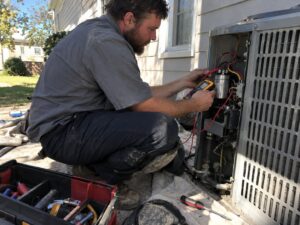
A composite drawn from the AC repair calls we run across Jessamine County. The diagnostics, decisions, and outcomes are real to how we work; the customer name, exact address, and dollar figures are left out for privacy. This isn’t a customer testimonial — see our testimonials page for actual reviews.
The R-22 refrigerant cost spiral has rewritten the repair-vs-replace math on aging Nicholasville AC equipment. A system that would have been a routine refrigerant top-off five years ago is now a replacement conversation, because the refrigerant itself can run more than the labor.
The Scenario
July afternoon, 92°F outdoor. A homeowner in Brannon Crossing, in one of the homes built during the 2003 wave of subdivision construction, calls about an AC that’s been cooling poorly for 36 hours. They waited a day to see if it would resolve. It didn’t — indoor temperatures climbed into the upper 70s and the system is clearly losing the battle.
The equipment is original to the home: a 22-year-old 13 SEER R-22 split system, builder-grade, almost certainly from one of the major OEM families (Carrier, Goodman, or Rheem depending on the construction contract that year). There’s been previous service history: a capacitor replacement four years ago, a refrigerant top-off two seasons back. The homeowner has been weighing replacement for several summers but kept extending the system “for one more season.” This is the call where one more season is no longer the obvious answer.
The home is 1,950 square feet, two-story conventional construction on slab. Ductwork is original-installation, accessible in the attic and crawl, in adequate condition.
What We Did on the Assessment
- Visual inspection of indoor coil — looking for ice formation or visible damage. No visible ice at this time.
- Filter and airflow check — filter recently replaced, blower running at proper speed.
- Refrigerant pressure measurement — suction pressure significantly below normal range for R-22 at current operating conditions. Discharge pressure also below normal. System running starved for refrigerant.
- Superheat and subcooling measurements — both readings consistent with substantial refrigerant loss.
- Electronic leak detector survey — flagged the evaporator coil with consistent leak signal, suggesting formicary corrosion progression from the previous slow-leak situation.
- Equipment age verification — confirmed manufacture date on outdoor unit nameplate matched the homeowner’s 2003 installation recollection (within manufacturer date code).
- Refrigerant type confirmation — R-22 on nameplate, consistent with installation era.
- Documentation of all findings before discussing repair options.
What We Found
The diagnosis pointed to a significant refrigerant leak on a 22-year-old R-22 system. The repair options:
- Refrigerant top-off only. Add R-22 to bring system back to operating charge without addressing the underlying leak. The cheapest first-cost option but a temporary fix — refrigerant continues to leak, system performance degrades, and the cost recurs each season.
- Leak repair plus refrigerant. Identify and seal the leak source, recover existing R-22 to recycling, repair the coil or component, recharge with refrigerant. On this system, the leak source is almost certainly the evaporator coil (formicary corrosion progression), which requires coil replacement.
- Replace the system. 22-year-old equipment past expected service life, with significant repair cost coming due, on obsolete refrigerant whose cost continues climbing. New equipment uses R-454B (Opteon XL41), the current standard A2L refrigerant.
The R-22 Cost Spiral Math
The factor that shifts this scenario’s economics from previous-era thinking:
- R-22 production ended January 1, 2020, per EPA’s Montreal Protocol implementation. Supply is reclaimed/recycled material only.
- R-22 cost has climbed substantially since 2020 production end. Refrigerant cost alone runs $100–200 per pound and continues climbing as supply tightens. A residential R-22 system charge of 4–6 pounds means refrigerant for a recharge alone can exceed $1,000.
- Leak repair plus refrigerant on an old coil means investing significant dollars in a system whose other components (compressor, condenser fan motor, control board) are statistically headed for failure in the next few years.
- Section 25C tax credit on qualifying high-efficiency replacement can meaningfully reduce effective first cost on new system, particularly heat pump replacements that qualify under more generous terms than straight AC.
The honest math pointed toward replacement rather than continued repair. The homeowner had been deferring the decision for several seasons; this leak was the event that made deferral no longer reasonable.
The Replacement Conversation
Walking the homeowner through the replacement options included:
- Manual J load calculation for current envelope condition.
- Equipment tier options from 15 SEER2 base-efficiency straight AC through 18+ SEER2 two-stage heat pump.
- Section 25C tax credit handling on qualifying tiers (homeowner to confirm specifics with tax professional).
- Jessamine County permitting rather than LFUCG.
- Refrigerant line compatibility — existing R-22 lines can typically be flushed and reused for R-454B installations per manufacturer specifications, reducing installation cost vs. full line replacement.
- Existing ductwork verification — static pressure measurement confirmed existing ductwork adequate for new system’s design airflow.
The Stopgap Decision
A practical question came up: the homeowner needed cooling restored quickly given the July heat, but full installation would take several days to schedule equipment delivery. We offered an interim solution: refrigerant top-off to restore cooling for the immediate week, with full replacement scheduled for the following week. This compromise let the family maintain cooling during the heat wave while making the replacement decision deliberately rather than under panic. Refrigerant top-off was an acknowledged temporary measure, not a recommended ongoing repair, with the homeowner understanding the underlying leak would continue.
The Outcome
Temporary refrigerant top-off restored cooling within the day. Replacement scheduled for the following Tuesday with new 16 SEER2 heat pump in dual-fuel configuration with existing gas furnace. New installation included new evaporator coil (eliminating the formicary corrosion leak), R-454B refrigerant (current standard), Jessamine County permitting, full commissioning measurements documented at startup. Section 25C tax credit eligibility confirmed by homeowner with tax professional. The 22-year deferred replacement was completed at the seasonal moment that made financial sense.
What This Profile Doesn’t Cover
- Newer R-410A systems (2010–2024 era) face different repair economics, since R-410A remains reasonably priced and widely available.
- Smaller leak situations on R-22 systems sometimes still justify repair if the equipment is otherwise healthy and several years from replacement consideration.
- Capacitor failures, contactor failures, and other simple electrical repairs follow different diagnostic and repair paths.
- Refrigerant top-off without leak repair is recommended only as acknowledged temporary measure, not ongoing maintenance practice.
Pricing Framework
For AC repair calls on aging R-22 equipment in Nicholasville, the cost categories typically work out:
- Refrigerant top-off — cost dominated by current R-22 pricing, which has climbed substantially.
- Leak repair plus refrigerant — coil replacement labor plus R-22 charge plus recovery of any salvageable refrigerant.
- Full system replacement — new equipment, labor, R-454B refrigerant, electrical, Jessamine County permits, commissioning, Section 25C credit partially offsetting first cost on qualifying installations.
The honest comparison shows when replacement becomes the more economical choice over time, even though first-cost is higher than repair.
Frequently Asked Questions
- Why has R-22 refrigerant gotten so expensive?
- R-22 production ended January 1, 2020, per EPA’s Montreal Protocol implementation phasing out ozone-depleting refrigerants. Supply since then has been reclaimed/recycled material only, with demand still high from systems still in service. Cost has risen substantially as supply tightens.
- Should I always replace an R-22 system instead of repairing it?
- Not always, but the math has shifted. R-22 systems past 15 years with significant refrigerant requirements often produce better total economics through replacement, particularly with Section 25C tax credit eligibility on qualifying high-efficiency replacements. Smaller repairs on otherwise healthy systems can still make sense. We work through the specific math for your situation.
- Is refrigerant top-off ever a good idea?
- As an acknowledged temporary measure to restore cooling while making a deliberate replacement decision: yes. As an ongoing repair practice on a leaking system: no. Refrigerant doesn’t get consumed; it leaks out, which means there’s a leak that needs to be addressed. We won’t recommend ongoing top-off without leak repair as a long-term approach.
- How does the line set compatibility work between R-22 and R-454B?
- Most R-22 line sets can be flushed and reused for R-454B installations per equipment manufacturer specifications, since the line set materials are compatible across these refrigerants. We verify line condition during the assessment and recommend replacement only if necessary.
- What’s Jessamine County permitting like?
- Similar to LFUCG, with permits required for major HVAC installations and inspection completed before commissioning. We pull permits and arrange inspection as part of installation work.
Schedule AC Repair Assessment in Nicholasville
If you have an R-22 system that’s struggling or has stopped cooling, or you’re considering whether continued repair makes sense vs. replacement, get in touch for honest math on your specific situation.
- Phone: (859) 215-5241
- Address: 343 Cassidy Ave, Lexington, KY 40502